



Product information
About
Two crisp biscuits with a cocoa cream between them, twelve to a box, in four sealed packs of three. The biscuit is a langue de chat, French for "cat's tongue", the flat oval biscuit this one is built from. It's an everyday Japanese supermarket sweet, and the thing to understand before you buy is that the biscuit leads and the chocolate accompanies.
That isn't a criticism, but it is the whole argument. The cream layer is thin and deliberately restrained, and people divide sharply over it. If you want a chocolate hit, buy chocolate. If you want a biscuit that happens to have cocoa in it, that is exactly what this is. Ito Biscuits has been making the Languly line since 1979, and had sold 150 million units across the whole line by its fortieth anniversary.
ラングリー チョコレートクリーム: the name on the box, if you're matching it to something you saw in Japan. The brand reads rangurii.
What you're getting
- Taste: Sweet, but the sweetness sits in the biscuit rather than the filling. The cocoa cream is quiet and faintly bitter against it, steadying the biscuit rather than adding to it.
- Texture: Fine-grained and short, with a crumble to it rather than a hard snap, and a browned rim around each biscuit. It's thicker than the delicate French biscuit the name promises.
- What the filling actually is: In Japan it's labelled jun-chocolate, a defined lower grade: at least 15% cocoa solids where chocolate proper needs 35%, and made with vegetable fat rather than cocoa butter. It's a cocoa cream, and we'd rather say so than let the word "chocolate" do work it hasn't earned.
- The bit Australians don't expect: There's no big bag. The twelve come as four sealed packs of three, so the rest stay crisp once you've opened one.
- The honest caveat: It's a dry biscuit and it takes some moisture with it. Have a drink to hand; black coffee is the natural one.
- Allergens: Contains wheat, egg, milk and soy. Read the pack's own label before you rely on ours.
Not to be confused with the same maker's Languly Premium Shocola, which is a richer, separate product: cocoa blended into the biscuit itself and a white chocolate cream. This is the standard one.
In warm weather the cocoa cream can soften, so treat it as a summer consideration rather than a surprise: heat, not handling, is the risk here, because the sealed inner packs do the protecting rather than the outer box.
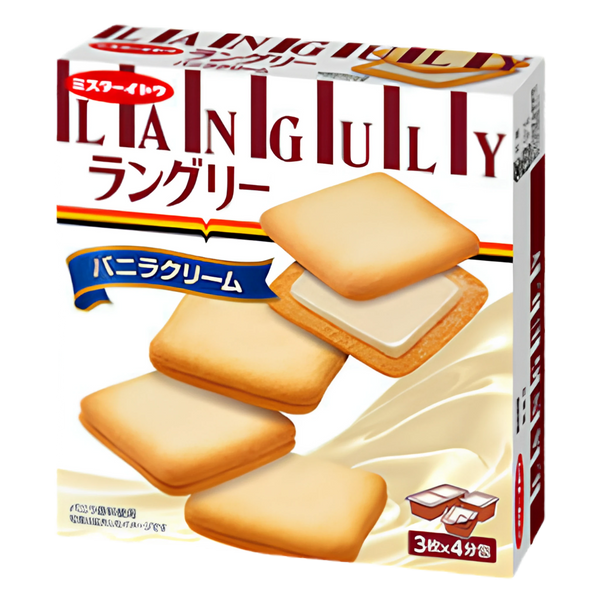
Take one box if you're trying it. The vanilla version of the same biscuit sits beside it on the shelf, and the two are worth reading side by side before you choose.
Ingredients
The maker's ingredient list, translated from the Japanese pack. Anything after the break is an additive — the Japanese label lists those separately.
Wheat flour (produced in Japan), jun-chocolate — this is the cream — (sugar, vegetable oil, cocoa, whole milk powder, cocoa mass, skim milk powder), beet sugar, margarine, shortening, egg, egg white, salt
emulsifier, flavouring. Contains wheat, egg, milk and soy.
The printed label on the pack is always the authority on ingredients and allergens, not this page — please read it in full before you rely on our summary. If you are unsure about an ingredient, contact us.
Allergens
The maker declares:
- Allergens
-
- Wheat
- Egg
- Milk
- Soy
The printed label on the pack is always the authority on ingredients and allergens, not this page — please read it in full before you rely on our summary. If you are unsure about an ingredient, contact us.
Details
- Maker
- Ito Biscuits Co., Ltd.
- Prefecture
- Ibaraki
- Made in
- Japan
- Net contents
- 12 biscuits, four sealed packs of three
Our guide
How to eat it
- Open them one at a time: a single sealed pack survives a day in a bag without turning to crumbs.
- Chill it in summer. Cold, the biscuit goes crisper and the cocoa sharpens: that holds for this flavour, not for the vanilla.
In their own words
What Japanese buyers say
- What they like
The pale cookie part's crisp texture is irresistible.
「白いクッキー部分のサクサク食感がたまらない。」
from monolog
- What they grumble about
I'd imagined a thin cookie with plenty of chocolate, so it wasn't what I expected and I let myself be disappointed. It's a thick, solid cookie with a thin smear of chocolate cream inside.
「クッキーは薄くてチョコたっぷりめを想像していたため、予想と違って勝手にがっかりしてしまいました。分厚いしっかりしたクッキーにうっすらチョコクリームが挟まれています。」
from mognavi
- What they like
Light on the tongue yet crisp — the langue de chat is quite thick, so the texture is fun.
「軽い口当たりなのにサクサクのラングドシャは、結構分厚いので食感が楽しいです。」
from mognavi
- What they like
Crisp-crumbly dough that melts nicely, with a thin layer of chocolate cream.
「サクほろの口どけの良い生地に、うっすらチョコクリーム。」
from mognavi
- What they like
Packed three at a time, so it's handy for portioning. It also stops you overeating, which is good.
「3枚ずつパックになってるので小分けにも便利。食べ過ぎ防止にもなって良いです。」
from monolog
- What they grumble about
The cream inside isn't a rich cream — it has a cheap feel, like "we kept it restrained to let the outer langue de chat shine".
「中のクリームは濃厚なクリームではなく、外側のラングドシャを引き立たせる為に控えめにしましたよ〜って感じのチープ感。」
from mognavi
- What they like
Chocolate cream sandwiched inside, delicious — and being packed in small portions it doesn't go soft on you.
「チョコクリームがサンドされていて美味しいです 小分けにパックされているので湿気らずに食べれます」
from monolog
- What they like
Being in small packs, I can put it out as the kids' snack with no fighting. Crisp and delicious.
「小分けになっているので、子供達のおやつに出しても喧嘩無しです(o^^o)サクサクで美味しい♪」
from monolog
- What they like
The cookie is surprisingly thick and each one is satisfying. Laid out properly on a plate, it could work as a sweet for entertaining!
「クッキーが意外と厚みがあって、一枚一枚が食べ応えあります。 ちゃんとお皿に並べたら、おもてなしのお菓子にも使えそうです!」
from monolog
- What they grumble about
It says "a gentle melt in the mouth", and that's certainly true. I personally wanted a bit more of a crunchy bite. The chocolate cream is thin and restrained in sweetness, but the langue de chat is sweet.
「やさしい口どけと書いてありますが、確かにそうです。私には、もう少しザクっとした歯ごたえが欲しかったです。チョコクリームが薄く、甘さ控えめですが、ラングドシャは甘いです。」
from mognavi
- What they like
Having it at teatime or coffee time is definitely an option! Because the packs divide up, you don't have to eat it all at once and you can share it.
「ティータイムやコーヒータイムに頂くのもアリかもしれませんね!パックを小分け出来る為、一度に食べる必要もなく、シェアして食べる事も可能です。」
from monolog
- What they like
It's quite sweet, so with black coffee is the way to go.
「結構甘いから、ブラックコーヒーと一緒が◎」
from mognavi
- What they like
In our house we chill it in the freezer — the texture becomes seriously substantial and it's so good you can't stop.
「冷凍庫で冷やして食べる我が家 めっちゃ食べ応えのある食感になって、止まらなくなる美味しさです!」
from monolog
- What they grumble about
It takes a fair bit of moisture out of your mouth, so it's a sweet that wants a drink alongside.
「口の水分を結構 持っていかれるので、飲み物が欲しいお菓子です」
- What they like
The langue-de-chat part is on the thick side and properly satisfying. If you're expecting the balance of a "Shiroi Koibito", this is an entirely different thing.
「ラングドシャ部分が厚めで食べ応えしっかり。所謂『白い恋人』のバランスを期待すると、全然違うものです。」
from monolog
Real quotes from Japanese review sites, translated by us. We show no star rating from those sites.
The maker
Where it comes from
- Ito Biscuits Co., Ltd.
- Ibaraki
Ito Biscuits calls itself a cookie and biscuit specialist, and that is genuinely all it makes, no chocolate bars, no crisps, no drinks. Languly has been in production since 1979.
The biscuits are baked at the company's own factory in Omitama, in Ibaraki, north-east of Tokyo.
The thing they talk about most is the dough. They add an extra mixing stage to it, and they tune the oven's humidity as well as its heat to the state the dough is in. The browned rim around the edge of each biscuit is how they tell it worked.
Product facts here are checked against the maker's own page: mr-ito-shop.jp (opens in a new tab)
Often bought together
-

Mister Ito Languly Chocolate Cream Biscuits — 12 Pieces
$4.93
You are on this one
