
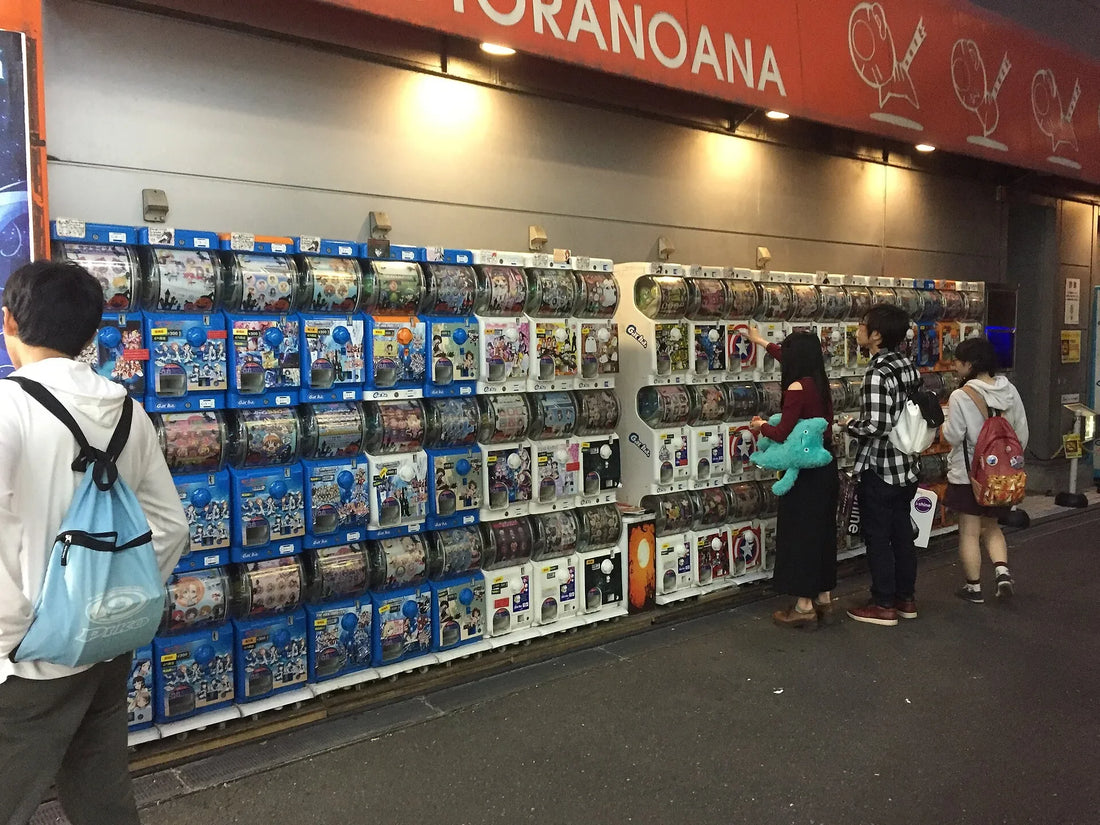
You've seen them in a Tokyo station, or lately in a Sydney shopping centre: a wall of little machines, each with a picture card of tiny toys and a handle to turn. Someone called it gashapon (ガシャポン), and you'd like to know what you're actually paying for.
It's Japan's capsule toy, and it's simple once you've seen one turn. Below is how it works, why grown-ups in Japan play it, and where to find gashapon in Sydney and Melbourne.
Quick answer
- What it isA vending machine that drops one small toy, sealed in a plastic ball, picked at random from a set shown on the front.
- The nameGashapon is the brand of Bandai, the Japanese toy company behind Tamagotchi. Takara Tomy Arts, from the Tomica and Beyblade toy group, calls its machines Gacha. Other makers use their own names, and the category is capsule toys.
- In AustraliaBandai has its own store in Haymarket, Sydney, and two in Melbourne, and the Gacha Gacha chain has 13 spots around Sydney. See where
What is a gashapon?
A gashapon is a vending machine for one small toy. You pay, turn the handle, and a plastic ball drops out holding one toy from the set pictured on the front, though you don't get to choose which.
The name is a sound. Turn the handle and it goes gasha, then the capsule drops out, pon. Bandai, the Japanese toy company, named its machines after those two sounds, and Gashapon is still its registered brand. The machines themselves came to Japan from the United States in 1965, and Bandai joined in 1977 with a 100-yen machine when 20 yen was the norm.
How do you play one?

Every machine sells one set, and a turn takes four steps.
- Pick a set from the card. The card on the front shows every toy in it and the price of one turn.
- Put the coins in. In Japan that's mostly 100-yen coins, and Bandai's machines now take coins from 100 to 500 yen.
- Turn the handle one full turn. You'll hear the gasha, then the capsule drops into the chute.
- Open the capsule. It's one toy from the set, and you don't know which until it's open.
Because you can't choose, a whole set takes several turns, and swapping doubles with friends is part of the fun. A turn in Japan usually costs 200 to 400 yen, with bigger premium capsules costing more.
Why do grown-ups in Japan play them?

If you've wondered who all those machines are for, it's grown-ups too, because the toys are made for them. In a 2025 survey of Japanese adults aged 20 to 69, 52.7% said they'd bought a capsule toy, and the biggest single group of toys was anime, manga and game characters. Chiikawa, the little white comic character on so many keyrings here, has capsule toys of its own, and our guide to Chiikawa says who's who.
The other big draw is the miniature: tiny, faithful copies of ordinary things, like microscopes, shaved-ice makers, water coolers or the stop button from a Japanese bus.
Most people buy them where they already are. Three in four buyers in that survey got theirs in a supermarket, a shopping centre or a department store. Whole shops of machines have opened too, and Bandai's flagship in Ikebukuro, Tokyo, now has more than 4,000 of them.
Is every capsule machine a gashapon?
Gashapon is Bandai's brand name, Takara Tomy Arts' machines are called Gacha, and the word on the front tells you who made the toy. Source: the trademark notices of Bandai and Takara Tomy Arts
So not every one is. Each maker puts its own name on the front. Bandai, the Japanese toy company behind Tamagotchi, calls its machines Gashapon. Takara Tomy Arts calls its machines Gacha. It's part of the Takara Tomy group, which makes Tomica toy cars and Beyblade spinning tops, and it has made capsule toys since 1986. Smaller makers such as Kitan Club have their own lines and their own names.
Look at the machine in the four steps above: it says Gacha, not Gashapon, because it's a Takara Tomy Arts machine. The wall at the top of this page in Akihabara, Tokyo's electronics district, is mostly Gacha machines too.
So when someone in Sydney says gashapon, they usually mean capsule toys in general. That matters when you go looking, because the two names lead to different shops. Bandai's own stores carry its Gashapon sets, while the Gacha Gacha chain runs on toys from Kitan Club, a Japanese capsule-toy maker.
Where to find gashapon in Sydney and Melbourne
Everything below was checked in October 2026 on each shop's own page.
One thing works differently here. Gacha Gacha's machines only take its own Gacha Gacha coins, which you buy with cash or a card from a coin machine beside them, and Capsule Station runs on tokens you can buy by card.
-
Sydney
Gashapon Bandai Official Store
Bandai's own capsule-toy store, with its Gashapon machines and collectibles from Japan.
-
Sydney
Gacha Gacha, Market City
Capsule machines from the Gacha Gacha chain in the Market City centre.
-
Sydney
Gacha Gacha, Kinokuniya
Gacha Gacha machines inside the Kinokuniya bookshop in The Galeries.
-
Sydney
Gacha Gacha, World Square
Gacha Gacha machines in the World Square centre on George Street.
-
North Sydney
Gacha Gacha, Greenwood Plaza
Gacha Gacha machines in Greenwood Plaza, North Sydney.
-
Melbourne
Gashapon Bandai Official Shop, Box Hill
Bandai's own capsule-toy store in Box Hill Central.
-
Melbourne
Gashapon Bandai Official Shop, The Glen
Bandai's capsule toys and figures in The Glen shopping centre.
-
Melbourne
Capsule Station
Hundreds of capsule-toy machines from Japan, with new sets every month.
-
Brisbane
Gacha Gacha, Mt Gravatt
The Gacha Gacha chain's Queensland machines.
More Gacha Gacha. The chain has 13 spots around Sydney in all, including Hurstville and Kogarah stations, Burwood, Central Park, Circular Quay and Chinatown. In Melbourne it's also at Melbourne Central and Southern Cross station. Its own locator has the full list.
Common questions
What is the difference between gachapon and Gashapon?
Gashapon is Bandai's registered brand name for its capsule-toy machines. Gachapon is the spelling many people use for any maker's machine, and Takara Tomy Arts brands its own machines Gacha. Whatever the word on the front, what comes out is a capsule toy: one small toy, picked at random from a set.
Why is it called gachapon?
It's called gachapon, or gashapon, after two sounds. Turning the handle goes gasha, and the capsule holding the toy drops out with a pon. Bandai named its machines Gashapon after exactly those sounds. In Japan, people call any maker's capsule machine gacha gacha in everyday speech.
How much does a gashapon cost?
A gashapon in Japan usually costs 200 to 400 yen a turn, paid mostly in 100-yen coins. At Gacha Gacha and Capsule Station in Australia, you first buy the shop's own coins or tokens: Gacha Gacha's machines only take Gacha Gacha coins, and Capsule Station sells tokens by card.
Where can I find gashapon?
In Sydney you can find gashapon at Bandai's own Gashapon Bandai Official Store in the Prince Centre, Haymarket, and at the Gacha Gacha chain's 13 spots, from Market City to North Sydney. In Melbourne, Bandai has stores in Box Hill and Glen Waverley, and Capsule Station is in Melbourne Central.
A turn or two is the quickest taste of Japan in the city. If it leaves you wanting more, our Japanese snacks are delivered across Australia, and if you're new to all of it, start here. Know a capsule-toy spot we've missed? Tell us.
Sources
- Bandai, ガシャポン40周年 (May 2017, in Japanese): the name, the 1977 100-yen machine, and coins from 100 to 500 yen.
- Takara Tomy Arts, ガチャ (in Japanese): the Gacha trademark and capsule toys since 1986.
- The makers' own pages: Tamagotchi (Bandai) and Takara Tomy's group companies, with its Tomica and Beyblade brands.
- nippon.com, カプセルトイ (in Japanese): the 1965 arrival from the US and the miniature craze.
- Cross Marketing, カプセルトイに関する調査 (August 2025, in Japanese): who buys, where, which toys.
- Bandai Namco Amusement, Gashapon no Depāto (Gashapon department stores, in Japanese): the Ikebukuro flagship's machine count.
- Checked October 2026 on the shops' own pages: Gashapon Bandai Official Australia, The Glen, Gacha Gacha and Capsule Station.
Photographs — all from Wikimedia Commons, used under the licences shown: Top photograph by Ominae (CC BY-SA 4.0); Microscope machine and Gacha Gacha no Mori by KKPCW (CC BY-SA 4.0).