
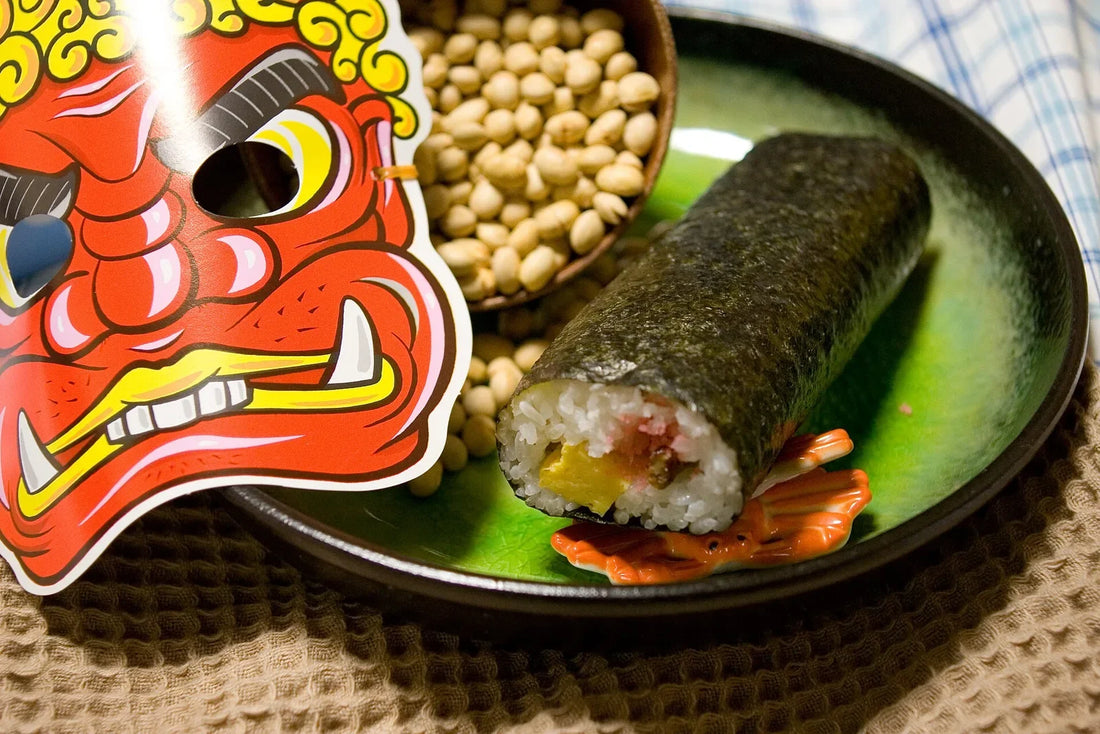
Early February, and your Japanese friend's photos fill up with beans: a little wooden box of them, a paper ogre mask, and a fat sushi roll that nobody has sliced. Someone in the family played the ogre and got pelted. What you saw was Setsubun (節分), a name meaning the dividing of the seasons, the night Japan throws beans to drive out bad luck before spring.
Find what you saw below. Then how to do Setsubun in Australia covers the beans, the roll and when it next comes round.
Quick answer
- What it isThe eve of spring on Japan's old calendar, usually 3 February. Families throw roasted soybeans at whoever wears the ogre mask, shouting demons out, luck in, then eat a bean for each year of their age.
- The rollEhōmaki, a thick sushi roll eaten whole and in silence, facing the year's lucky direction. In 2027 that's north-north-west.
- Doing it herePeanuts in the shell from the supermarket do the job, just as they do across northern Japan. JFC Online Melbourne gathers what you need to roll an ehōmaki, and Komaru in Neutral Bay has made them to order in past years, so ask in January. How to do it here
What you saw on Setsubun
Five things turn up around 3 February. Start with the one in your photo.
-

Fukumame (福豆)
Pale roasted soybeans, often in a square wooden box
means lucky beans; in Japan's far north, peanuts in the shell
-

Oni mask (鬼の面)
A paper ogre face with horns and fangs
-

Ehōmaki (恵方巻)
A thick sushi roll left whole, never sliced
-

Hiiragi iwashi (柊鰯)
A spiky holly sprig with a dried fish head, by a front door
said to keep ogres out: the holly pricks their eyes, the smell drives them off
-

Mamemaki (豆まき)
A crowd with hands up, catching beans thrown from a temple or shrine stage
means bean-scattering; Sensō-ji, a big Tokyo temple, draws one of the largest crowds
Why does Japan throw beans at an ogre?
The ogre is an oni (鬼), the horned brute of Japanese folklore. On Setsubun it stands for whatever bad luck the coming year might bring. Throwing beans drives it out of the house, and the shout tells it where to go: oni wa soto, fuku wa uchi, demons out, good luck in.
The chasing came from China. A court rite called tsuina, which drove plague demons out on the last night of the year, reached Japan in the late 600s. Setsubun is the day before Risshun, the first day of spring on Japan's old calendar, and that calendar treated it as the year's last night. So the demon-chasing moved to it. Beans joined much later, from the Muromachi period, the 1330s to 1570s. China had used adzuki beans or grains. Japan chose soybeans, as a prayer for a good harvest.
You'll also hear that mame, bean, sounds like ma-metsu, destroy the demon, and that the beans are roasted so none can sprout. Those are sayings, not the history, but they're the ones people repeat.
Once the beans are thrown, everyone eats some: one for each year of their age, or one more for luck in the year ahead. That's why they're called fukumame, lucky beans.
Not everyone shouts the first half. Naritasan Shinshōji, a big temple east of Tokyo, only calls luck in, because its main Buddhist deity, Fudō Myōō, is said to reform even an ogre. Some families named Watanabe skip the beans, after a legendary ogre-slayer of that name, and places with oni in their name may call the ogres in.
The sushi roll you eat in silence
The other half of Setsubun is ehōmaki (恵方巻), the lucky-direction roll: a thick sushi roll with several fillings, eaten whole. The rules are few and firm. Face the year's ehō, its lucky direction, and make a wish. Don't cut the roll, so your ties don't get cut. Eat it all without a word, so the luck can't slip out.
The direction is where the year's god of good fortune, Toshitokujin, is said to sit, and it's always one of four: east-north-east, west-south-west, south-south-east or north-north-west. In 2027 it's north-north-west, which a compass app finds as easily in Sydney as in Osaka.
Is ehōmaki an ancient tradition?

With rules like that, it sounds ancient. As a national habit, it isn't. Japan's agriculture ministry says nobody is sure where it began. The stories point to merchant houses or the geisha districts of Osaka, in western Japan. By the 1910s, Osaka's geisha districts ate a whole, uncut roll at Setsubun. Even so, it wasn't widespread until after the Second World War.
Then it was sold. Nori sellers promoted it from the 1970s, and in the 1990s convenience stores and supermarkets began stocking it, which spread it across the country. 7-Eleven took the name ehōmaki nationwide in 1998. The seven fillings, said to honour the Seven Lucky Gods, are newer still: the ministry calls them a recent fashion.
Success brought its own problem. So many unsold rolls were thrown away after Setsubun that in 2019 the ministry asked shops to make only what they could sell, and it has listed the shops that signed up every year since. The beans are old. The roll you eat in silence is, as a nationwide custom, about thirty years old.
How to do Setsubun in Australia
Setsubun next comes round on a Wednesday, the third of February, in 2027. It moves with the old calendar, landing on 2 February in some years, as it did in 2025. It's the eve of spring in Japan, but here it lands in late summer, so the beans go out into a warm evening. You won't find much ready-made, and you don't need much.
Everything below was checked in October 2026. Prices are a rough guide, not a quote.
The beans. None of the Japanese grocers selling online here, JFC, Jun Direct and Umall among them, listed roasted Setsubun soybeans, though October is months before the season. The easy swap is the one Japan's far north already makes: peanuts in the shell. In Hokkaido, the northern island Sapporo is on, and Tōhoku, the region north of Tokyo, about eight households in ten throw peanuts, because they're easy to find in snow and clean to eat once picked up. Woolworths sells peanuts in the shell for around $5 to $7 a bag.
The ogre. A paper oni mask is the usual thing in Japan, and any horned, fanged face drawn on card does the same job. Whoever wears it gets pelted, so choose someone who'll laugh.
The roll. JFC Online Melbourne keeps a Setsubun collection with what you need to roll your own: nori, the seaweed sheets, sushi rice, a bamboo rolling mat, rolled omelette and kanpyō, seasoned gourd strips. Or have one made:
-
Sydney
Komaru
A sushi bar known for Osaka-style pressed sushi. Its chef, Hiroyuki Nagashima, has made ehōmaki to order for Setsubun in past years, so ask in January.
On the night, it goes in four steps.
- Pick your ogre. One person puts on the mask.
- Drive it out. Throw beans at the ogre, or out the front door, shouting oni wa soto, fuku wa uchi.
- Eat your age. Pick up one bean or peanut for each year of your age, plus one if you like, and eat them.
- Face north-north-west. Eat your ehōmaki whole and in silence, making a wish.
If a shop near you makes ehōmaki or sells Setsubun beans, tell us and we'll add it.
Common questions
What is Setsubun and what is it associated with?
Setsubun is the day before the first day of spring on Japan's old calendar, usually 3 February. It's associated with mamemaki, throwing roasted soybeans at someone in an ogre mask to drive out bad luck. People then eat a bean for each year of their age, and a whole sushi roll, ehōmaki, in silence.
Why do you throw beans at oni?
You throw beans at oni, ogres from Japanese folklore, to drive the coming year's bad luck out of the house. The custom grew from tsuina, a Chinese rite for chasing out plague demons at year's end. Japan chose soybeans as a prayer for a good harvest.
When is the next Setsubun festival?
The next Setsubun is on a Wednesday, the third of February, the day before Risshun, the first day of spring on Japan's old calendar. The date isn't fixed: it moves with Risshun, so it fell on 2 February in 2021 and 2025. In 2027 the lucky direction for eating ehōmaki is north-north-west.
How is ehomaki different from sushi rolls?
Ehōmaki is a thick sushi roll, usually with several fillings, that's eaten whole on Setsubun instead of being sliced into pieces. You face the year's lucky direction, make a wish and eat it without speaking. The roll itself is like an ordinary thick roll; what makes it ehōmaki is the day and the rules.
Where this leaves you
The beans, the paper ogre and the uncut roll were Setsubun, Japan's eve of spring, and you can hold one here with a bag of peanuts and a compass. We don't sell Setsubun beans or ehōmaki. If you'd like something Japanese to snack on that night, our Japanese snacks are the place to look, and if you're new to Japanese food altogether, start here.
Sources
- National Diet Library, Collaborative Reference Database: 追儺 and Setsubun (the court rite and its date) and why soybeans, and where peanuts are thrown (citing the national peanut association).
- Ministry of Agriculture, Forestry and Fisheries, うちの郷土料理: 恵方巻 (origin, spread and the rules) and selling seasonal foods to demand (the 2019 request).
- National Astronomical Observatory of Japan, 暦要項 2027: Setsubun and Risshun dates.
- Naritasan Shinshōji, よくある質問: why the temple calls only luck in.
- Japanese Wikipedia, 節分: the dates, fukumame, the chant's variants and the four lucky directions.
- Australian sources, from their own pages: JFC Online Melbourne's Setsubun collection, Woolworths, Komaru and SBS Japanese on its ehōmaki.
- Australian availability checked October 2026 on the retailers' own online stores: JFC Online, Jun Direct and Umall, among others.
Photographs — all from Wikimedia Commons, used under the licences shown: Top photograph by sakura_chihaya+ (CC BY-SA 2.0); Fukumame by katorisi (CC BY-SA 3.0); Oni mask by Yutah123 (CC BY-SA 3.0); Ehōmaki by zenjiro (CC BY 2.0); Hiiragi iwashi by Nesnad (CC BY 4.0); Mamemaki at Hakone Shrine by KQuhen (CC BY-SA 4.0); the 7-Eleven banner by Jin Kemoole (CC BY 2.0).