
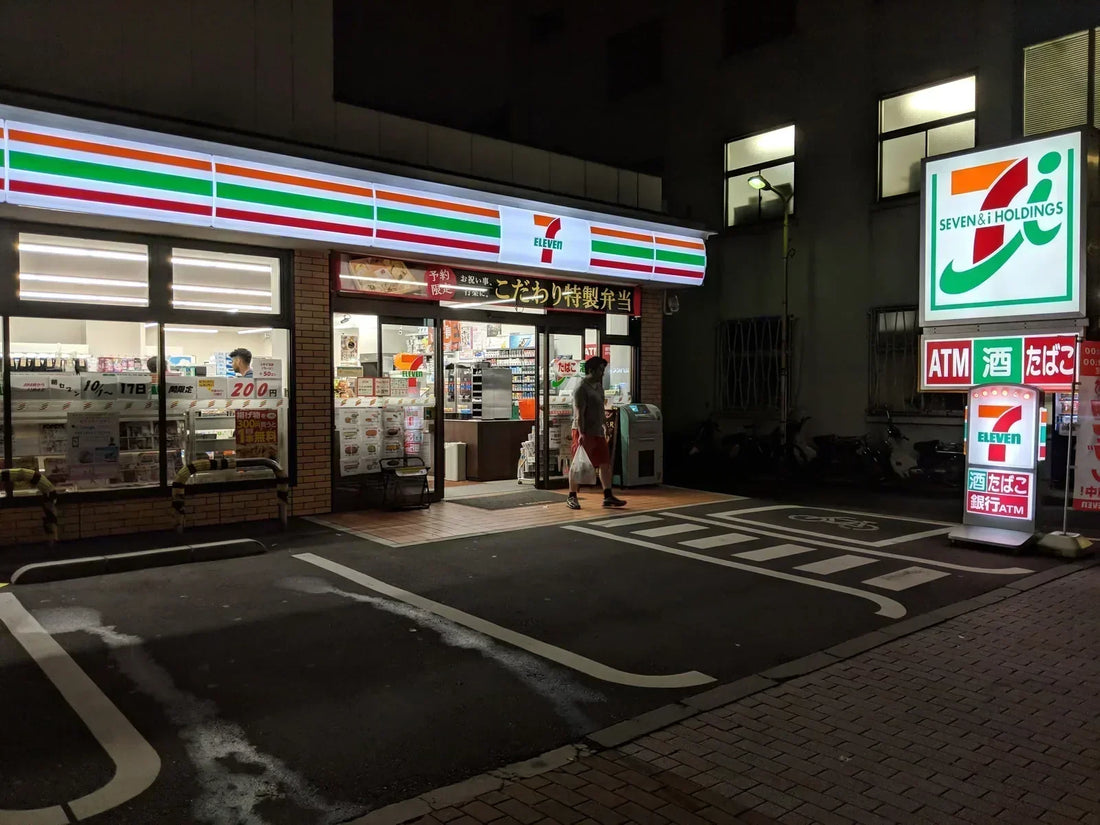
You went in for a bottle of water at eleven at night and came out with a rice triangle, an egg sandwich and a hot coffee, and all three were better than they had any right to be. Then you did it again the next morning. That shop was a konbini, the Japanese word for a convenience store. The odd thing about coming home is that nothing here quite matches it.
Let's work out which of the three big chains you were standing in, and what it sold you. Then the real question: why the food was that good. And at the end, where to get closest to it in Australia, starting with your local 7-Eleven: a Japanese company bought the Australian chain in 2024, and that's why there are onigiri, the rice triangles, in its fridge.
Quick answer
- What it isThe Japanese word for a convenience store. Three big chains cover the country, and the food is the reason people remember them.
- What it sold youMost often onigiri, the rice triangle in the peel-apart wrapper, alongside egg sandwiches and hot coffee.
- Getting close hereNobody has built the shop itself here, but three pieces of it exist. A Japanese company bought 7-Eleven Australia in 2024, and it sells onigiri in the peel-apart wrapper. What you can get here
Which konbini were you in?
Almost certainly one of three, and the quickest way back is what it sold you.
-

7-Eleven (セブン-イレブン)
Seven Café, its own coffee machine, and the tuna-mayo onigiri
About 21,700 shops, the biggest by a distance
-

FamilyMart (ファミリーマート)
Famichiki, the flat boneless fried chicken from the heated case by the till
Roughly 16,400 shops
-

Lawson (ローソン)
Karaage-kun, its fried chicken nuggets, and the tamago sando, the egg sandwich
About 14,600 shops. Bourdain called that sandwich unnatural, inexplicable deliciousness
Which is best is an argument Japanese people have too, and it doesn't have an answer. Add four smaller chains and Japan has 56,162 convenience stores, and between them about 47 million visits a day. You may also have been in Ministop, Daily Yamazaki or Poplar, or NewDays inside a train station. In Hokkaido, the northern island, the chain that matters is Seicomart.
What none of them is, is a supermarket. They're small, self-service and open when nothing else is, the part you noticed at eleven at night, though about one konbini in ten now keeps shorter hours. The other shop that stays open all night in Japan's big cities is Don Quijote, the discount store everyone in Japan calls Donki, and it has its own guide.
Nearly all the food lives on the chilled wall or in the heated case by the till. The chilled wall is what the shop is really for.
Why was the food that good?

It's not servo food that happens to be nicer. It's a different business. Fresh food made that day is the single biggest slice of what a konbini sells, at 35 per cent of takings: onigiri, sandwiches, bento, chilled noodles, the hot case. Packaged snacks are second. Everything you'd expect a convenience store to live on comes after. The dried and salted corner of it is otsumami, the snacks eaten with a drink, which our guide to otsumami takes apart. The sweet corner is where dorayaki, two small pancakes around sweet red bean paste, sits in its wrapper, and our guide to dorayaki sorts it from the three sweets people confuse it with.
That slice only works if the shelf is refilled while you sleep. 7-Eleven delivers food to each shop in three time bands a day: late night, morning and evening. So the onigiri you bought at seven in the morning was made overnight. The company is now trialling two bands instead of three, with longer use-by dates to match.
The system is old. In 1980, 7-Eleven cut the number of trucks calling at a shop each day from about seventy to nine by pooling suppliers onto shared runs.
The fresh shelf itself started earlier. In 1978 the company began selling the hand-rolled onigiri in a film wrapper, with the seaweed kept away from the rice until you pull the tab. Onigiri are far older than the shop. The wrapper is what let them sit in a fridge.
The other half of the answer is the price. An onigiri in Japan runs roughly ¥150 to ¥250, and that's after several rounds of rises: dearer than a supermarket, far cheaper than lunch out, and made overnight.
How to use the counter
Three things catch first-timers, and none of them is a problem once named.
The wrapper has numbers. An onigiri sleeve is marked 1, 2, 3. Pull the strip marked 1 straight down the front, then pull the two sides away in the order marked. The seaweed wraps itself around the rice as the plastic comes off. Tear it open any other way and you get seaweed in one hand and rice in the other.
The hot case isn't self-serve. Famichiki, Karaage-kun and nikuman, the steamed pork buns, sit behind the glass on the counter. You say the name or point, and the staff bag it. Oden works the same way, item by item: the winter tank of broth, with eggs, white radish and fish cakes in it.
You'll be asked a question. Atatamemasu ka means shall I heat it? It comes with any bento or hot meal. A nod is enough.
The 7-Eleven at home is now Japanese
7-Eleven is a Japanese-owned company. It's not an American chain that Japan happens to like. The Japanese business bought its American parent in 1991, and in 2024 it bought the Australian chain as well.
That's backwards from how it started. A Japanese supermarket group paid the American owner for the right to use the name in 1973, opened its first shop in Tokyo in 1974, and eighteen years later bought control of the company it had licensed from. Every 7-Eleven in the world has answered to Tokyo since.
In 2024 the same group completed the purchase of 7-Eleven Australia: more than 750 shops, for about A$1.7 billion. That's why onigiri appeared in the fridge at your local servo, in the same peel-apart wrapper. The Australian onigiri is made here by a sushi supplier, comes in six flavours, and costs about twice what it does in Japan. Same idea, not the same shop.
Where to find a konbini in Australia
Nobody has built the shop itself here: the chilled wall, the steamer cabinet, the tank of broth. But three pieces of it exist, and one of them is closer than you think. Everything below was checked in September 2026. Prices are a rough guide, not a quote.
The servo
7-Eleven Australia sells onigiri in six flavours, in the peel-apart wrapper, for about four dollars each, plus an egg salad roll, hand rolls, gyoza and cans of Boss coffee. It's the Japanese parent's product line arriving in a subsidiary, and it's the one thing on this list you can get at midnight.
The konbini-style shops
A handful of Japanese grocers have built themselves around the fresh counter rather than the shelf. Every address opens the shop on Google Maps, where its hours are current.
-
Sydney
Miso Mart
Calls itself the Japanese conveni experience, and makes onigiri in-house every morning.
-
Sydney
Conveni8
A small grocery by Town Hall that makes a point of its onigiri.
-
Sydney
Super Orange
Makes fresh onigiri daily.
-
Melbourne
Suupaa
The closest thing in the country to the real article: egg sando, fresh onigiri, noodles and coffee under the line "Japanese convenience".
-
Melbourne
Haiku Future
Describes itself as a konbini specialty store, groceries and deli.
-
Perth
Tokyo Food Mart by Hikaru
Sells conbini-style sandwiches, onigiri and bento.
The onigiri and sando counters
These are made while you wait, and you can expect to pay roughly $4 to $7 for a rice ball and $9 to $15 for a sandwich.
-
Sydney
Mogu Mogu Onigiri Community
Made to order, and also on the University of Sydney campus.
-
Sydney
Musubiya
Two locations, and the Chatswood one is a stall on some days of the week only.
-
Sydney
Sandoitchi
The egg-salad and katsu sando, and a second counter in Chatswood Chase.
-
Sydney
Itadakimasu
An onigiri café by day, next door to Sandoitchi.
-
Brisbane
FUFU Sando
Opened in July, and sold out its first weekend.
-
Perth
Omusubi Natchan
Makes onigiri at a stall on market days.
No business in Adelaide, Canberra or the Gold Coast advertises a konbini-style shop or an onigiri counter on its own page. If you know one, tell us and we'll check it.
Online, for the packaged half
The drinks and sweets travel. JFC Online, Jun Direct, Genki Mart, Umall, Asian Pantry and Snack Affair all carry cans of Boss coffee and Pocari Sweat. JFC and Snack Affair carry purin, the cup custard, and Genki Mart and Jun Direct carry the jelly drinks in the pouch. What none of them carry is the fresh counter: no steamed pork bun, no salad chicken, no egg sandwich beyond one chilled line at Umall. Oden comes only as a kit: a frozen bag of pieces and a sachet of soup base. That's the honest version of it here.
Common questions
What does konbini mean?
Konbini is the Japanese shortening of konbiniensu sutoa, the English words "convenience store" said in Japanese. It covers the whole category: 7-Eleven, FamilyMart, Lawson and the smaller chains. You'll also see it spelt conbini in English; Japanese has one word, written コンビニ.
What is a Japanese convenience store called?
A konbini. Japanese uses one word for the whole category, so 7-Eleven, FamilyMart, Lawson and the smaller regional chains all count. The word carries the fresh food with it: rice balls, sandwiches and hot counters are what separates a konbini from a servo.
Is 7-11 a konbini?
Yes. 7-Eleven is the biggest konbini chain in Japan, with about 21,700 shops. In Japanese it's called Sebun-Irebun, or just Sebun. It's the same brand as the Australian 7-Eleven, and since 2024 the same owner, but the Japanese shops carry a far larger fresh-food range.
Is 7-Eleven now Japanese owned?
Yes. Seven & i Holdings, the Japanese parent of 7-Eleven Japan, has controlled the original American company since 1991, and in 2024 it completed the purchase of 7-Eleven Australia for about A$1.7 billion. The chain that started in Texas has been run from Tokyo for over thirty years.
Does 7-11 Australia sell onigiri?
Yes. 7-Eleven Australia sells onigiri in six flavours, in the same peel-apart wrapper Japan uses, for about four dollars each. They are made here by a sushi supplier, not imported. The chain also stocks an egg salad roll, hand rolls, gyoza and cans of Boss coffee.
Is Lawson or 7-Eleven better?
Neither, and Japanese people argue about it too. 7-Eleven is known for its coffee machine and onigiri, Lawson for its fried chicken nuggets and sweets counter, and FamilyMart for its Famichiki fried chicken. Most people pick by what's nearest, then by which shop's egg sandwich they prefer.
What are the top 3 convenience stores in Japan?
7-Eleven, FamilyMart and Lawson, in that order and by a distance. 7-Eleven runs about 21,700 shops, FamilyMart roughly 16,400 and Lawson about 14,600. Ministop, Daily Yamazaki and Poplar come next, and in Hokkaido, the northern island, the one that matters is Seicomart.
Is 7-Eleven in Japan cheap?
Cheaper than a restaurant and dearer than a supermarket. Japan's statistics bureau priced the same everyday groceries across store types and konbini came out highest on every single one. It still costs less than a cheap lunch out in Japan.
How much does an onigiri cost at 7-Eleven?
About ¥150 to ¥250 in Japan, after several rounds of price rises. At 7-Eleven in Australia the same rice ball is about four dollars, which is roughly twice what it costs in Japan. Both are the same shape in the same peel-apart wrapper.
Where this leaves you
Three chains, one owner you didn't expect, a fridge that gets filled three times a day, and a servo down the road that's now, on paper, a branch of it. The packaged half of the konbini is the half that ships, and it's the half we carry. The Cup Noodle sizes you saw on the shelf are in Japanese instant noodles, Calbee's Kataage chips on the Japanese snack shelf, and the jelly drinks from the chiller in Japanese drinks.
If you're earlier in the journey than that, start here is the short version of what we carry.
Sources
- Japan Franchise Association, Convenience store statistics, July 2026 — the 56,162 store count across seven member chains, monthly sales and customer numbers, and the 35.4% share of daily fresh food.
- Seven & i Holdings, Seven-Eleven Japan's history and company chronology — the 1973 licence, the first shop in 1974, the 1978 film-wrapped onigiri, the 1980 delivery consolidation, the 1991 purchase of Southland, Seven Café in 2013, and the current store count from the group's monthly data; the bestseller descriptions from 7-Eleven Japan's visitor page.
- Seven & i Holdings, acquisition of 7-Eleven Australia, 30 November 2023, and 7-Eleven Australia, completion, 1 April 2024 — about A$1.7 billion, more than 750 stores.
- Lawson, company history — the milk-churn sign and Karaage-kun since 1986 — and FamilyMart, company history — Famichiki since 2006; store counts from Lawson's April 2026 monthly report and FamilyMart's April 2026 statement.
- Seven-Eleven Japan, delivery efficiency — the three daily delivery bands and the move to consolidate them.
- Anthony Bourdain, post from Tokyo, November 2013 — the Lawson egg salad sandwich.
- Australian availability checked in September 2026 on each business's own pages — 7-Eleven Australia, Suupaa, Miso Mart, Haiku Future, Mogu Mogu, Musubiya, Sandoitchi, Itadakimasu, JFC Online, Jun Direct, Genki Mart, Umall, Asian Pantry and Snack Affair; FUFU Sando from The Weekend Edition, August 2026.
- Statistics Bureau of Japan, prices by store format, December 2024 — konbini dearest of every store type on every item measured.
Photographs, all from Wikimedia Commons: 7-Eleven shopfront by John Seb Barber (CC BY 2.0); FamilyMart shopfront by LERK (CC BY-SA 4.0); Lawson shopfront by Jeffrey Hayes (CC BY 2.0); chilled wall by Thomas Woodtli (CC BY-SA 2.0); 7-Eleven at night by Michael Ocampo (CC BY 2.0; cropped for the guides index).


