
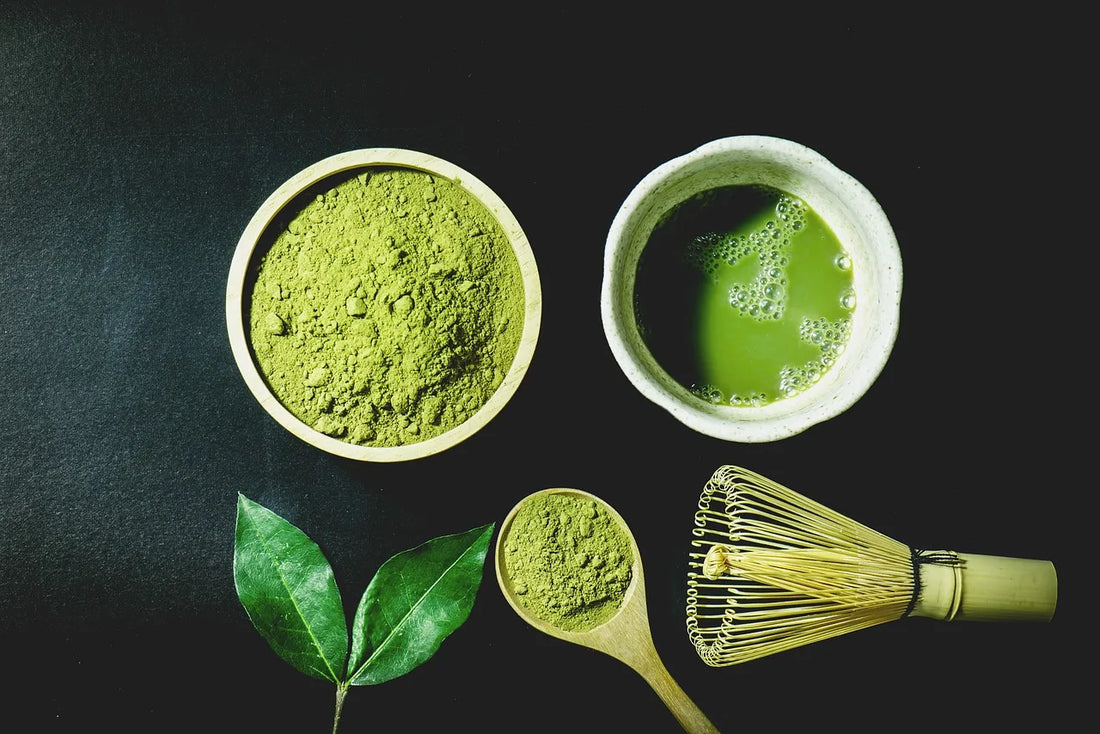
You're standing in front of a row of matcha tins, at Coles, at a Japanese grocer or online. One says ceremonial grade, the next says premium, a third says culinary, at three times the price of the cheapest. You'd like to know whether ceremonial grade matcha is the real thing and the rest isn't.
It isn't quite that. The words come from the sellers, and Japan sorts its matcha a different way. Below is what the labels mean, how Japan tells matcha from green tea powder, which kind suits a latte or a bowl, and where to buy matcha in Australia.
Quick answer
- What ceremonial meansWhatever the seller means by it. No Japanese standard defines ceremonial, premium, latte or culinary grade, so each shop's ladder is its own.
- What Japan goes byHow it's made: shaded tea leaves, dried flat, then milled. Green tea powder ground from ordinary leaves is a different product, even when it's green.
- In AustraliaColes, Woolworths and the Japanese grocers' online shops sell plain tins for lattes and baking, and tea shops in Sydney and Melbourne sell the pricier tins to drink straight. See where
What does ceremonial grade mean?
On a tin, ceremonial grade means the seller thinks this matcha is good enough to drink whisked with water alone, the way it's served at a Japanese tea ceremony.
But it isn't a grade anyone checks. Japan's tea trade has a labelling standard for green tea, and it has no grades for matcha at all, ceremonial and premium included. A Japanese tea seller puts it plainly: there's no official grading standard for matcha in Japan, and words like latte grade and culinary grade have no shared definition either. The international standards body, ISO, published a report on matcha in 2022, and it describes what matcha is without setting any rules.
So every shop builds its own ladder. In Sydney and Melbourne you'll find tins called ceremonial, premium ceremonial, imperial grade, standard, first harvest and culinary. The word tells you where a tin sits in that shop's range, not how it compares with the shop next door.
What makes it matcha in Japan?

Japan defines matcha by how it's made, and the recipe has four steps. The tea bushes are covered with reed screens or shade cloth for about two to three weeks before picking. The leaves are steamed, then dried flat without being rolled, which is how they become tencha (碾茶, the leaf for grinding). Last, the tencha is milled into a very fine powder.
That's also why matcha costs what it does. Tencha is only about 7 per cent of the tea Japan makes. Its dried leaf sells for nearly three times the price of sencha, the everyday green tea.
In Japan, matcha (抹茶) is tencha, tea grown under shade and dried without rolling, ground to a fine powder. Ordinary tea milled to powder is a separate product, called funmatsu-cha (粉末茶, powdered tea). Source: the Japan Tea Central Public Interest Incorporated Association, the tea industry's national body, in its green tea labelling standard
Two things you'll see on English labels aren't in the definition. It doesn't say which picking of the year the leaf comes from. And it doesn't require a stone mill: any mill that does the job as well as a stone one counts.
How does Japan sort its matcha, then?
By the bowl it's going into. A Japanese tea ceremony serves matcha two ways, with a small sweet such as nerikiri, the flower-shaped bean-paste sweet beside it.

Usucha (薄茶, thin tea) is the matcha most people know. It's about 2 grams, two small bamboo scoops, whisked into 50 to 80 millilitres of water at about 80°C until it foams. Each guest gets their own bowl.
Koicha (濃茶, thick tea) uses far more powder for the water, kneaded rather than whisked into a smooth, thick tea that's passed around one shared bowl.

Below both sits matcha for cooking. Japan's tea trade has one name for a lower tier, food-processing tencha (食品加工用碾茶), the autumn-picked leaf it sells to food makers for ice cream and sweets. Past that, price per gram is the real ladder. Tea bushes are picked several times a year, and the first picking in spring fetches more than twice the price of the second, with every later picking cheaper again.
That gives you a simple way to choose. For a latte, a smoothie or baking, Japanese makers sell their everyday tins. Ujinotsuyu, a Kyoto tea maker, sells its Hagoromo tin as an ingredient for drinks, sweets and cooking. If you'll drink it whisked with water alone, that's what the dearer tins at a tea shop are for.
Not every green powder on the shelf is matcha
Here's the part the grade labels never mention. On the same shelf as the matcha, an Australian grocer often has green tea powder that isn't matcha at all, and the word on the pack is the only way to tell.
| Matcha | Green tea powder | Blend | Latte mix | |
|---|---|---|---|---|
| On the pack | 抹茶 (matcha) | 粉末緑茶 (powdered green tea) or 粉末茶 (powdered tea) | 抹茶入り (with matcha added) | Latte, au lait or sweet in the name |
| What it is | Shaded tencha, milled | Ordinary green tea, milled | Green tea powder with some matcha | Matcha with other ingredients mixed in |
| Good for | A bowl, a latte, baking | A quick cup of green tea | Tea and baking | A drink straight from the packet |
Both lookalikes are real on Australian shelves. Kanpy's green tea powder lists one ingredient, tea from Shizuoka, a tea region south-west of Tokyo, and no matcha. Ogurinouen's 抹茶入り (matcha-iri) powder is green tea powder with some Uji matcha mixed in. In English, both just read green tea powder.
One more word worth reading is Uji (宇治), the town south of Kyoto most famous for matcha. Uji tea, by its official definition, is tea grown in Kyoto, Nara, Shiga or Mie and finished in Kyoto, not only tea from Uji. Some tins go further and say 宇治抹茶使用, made with Uji matcha.
Where to buy matcha in Australia
Everything below was checked in November 2026 on each shop's own website.
- On the shelf: Coles stocks plain matcha tins from Perfect Ted, Arkadia, Wellness Road and Tropeaka, and a tin from Ujinotsuyu, the Japanese maker.
- On the shelf: Woolworths has plain tins from Matcha Maiden, Arkadia and Honest To Goodness, beside several matcha latte mixes.
- On the shelf: ARC Asian Grocer, an online Asian grocer, carries Japanese-made tins from Maedaen, Hamasaen, Ujinotsuyu and Tsujiri.
- On the shelf: Genki Mart, a Japanese grocer's online shop, has matcha tins from Ujinotsuyu, Ooikawa and Nanaya.
For a tin you'll drink straight, these four tea shops sell matcha to take home.
-
Sydney
Simply Native
A Japanese tea shop with a long list of matcha tins, including one it sells for koicha.
-
Sydney
Quali-Tea
A tea shop selling its own Standard and Imperial Grade matcha, and an organic tin.
-
Sydney
Taka Tea Garden
A Japanese green tea importer with an Uji matcha among its teas.
-
Melbourne
Matcha Mate
A matcha shop selling its own tins, named by harvest and tea variety rather than grade.
Prices are a rough guide, not a quote. A plain tin of matcha runs roughly $8 to $30 at a supermarket or Japanese grocer. A tea shop's tins run roughly $40 to $60, and a few pass $100.
We sell one of those everyday tins ourselves, the Ujinotsuyu Hagoromo matcha, and deliver it across Australia. We call it culinary because its maker sells it for drinks, sweets and cooking. For the Japanese grocers themselves, our guide to Japanese grocery stores in Sydney has each one's range and online shop.
Common questions
What does ceremonial grade mean for matcha?
Ceremonial grade means the seller thinks the matcha is good enough to drink whisked with water alone, as at a Japanese tea ceremony. It isn't an official grade: Japan's tea industry has no grading standard for matcha, so each shop decides for itself which of its tins to call ceremonial.
Is ceremonial grade matcha actually better?
Ceremonial grade matcha is usually a shop's top or second tier, priced above its everyday tins, but it isn't better by any shared standard. One shop's ceremonial can cost twice another's, so compare tins by price per gram and by what you'll make. For a latte or baking, Japanese makers sell everyday tins.
What is the difference between green tea and matcha?
Matcha is green tea, but a particular kind: the leaves are shaded for about two to three weeks before picking, steamed, dried flat without rolling and milled to a fine powder. Ordinary green tea, like sencha, is rolled and brewed as leaves, and when it's milled to powder Japan calls it powdered tea, not matcha.
What is the lowest grade of matcha?
The lowest grade of matcha depends on the shop, since no standard ranks matcha. In Japan's tea trade, the one named lower tier is food-processing tencha, autumn-picked leaf sold to food makers. In Australia, a tin labelled culinary is one a shop sells for cooking and lattes, not for drinking straight.
A good tin of matcha and a bamboo whisk are a small taste of Japan at home. If you'd like more, our Japanese tea is delivered across Australia, and if you're new to all of it, start here. Know a matcha shop we should add? Tell us.
Sources
- Japan Tea Central Public Interest Incorporated Association, 緑茶の表示基準 (green tea labelling standard, revised July 2026, in Japanese): the definitions of matcha, tencha, powdered tea and food-processing tencha, and the mill.
- Norinchukin Research Institute, 抹茶の市場動向 (May 2026, in Japanese): the definition is not binding, tencha's share of Japan's tea, prices by picking, and Japan's uses for matcha.
- NARO, Japan's national agriculture research body, ISO/TR 21380 発行 (April 2022, in Japanese): the ISO report on matcha, which sets no rules.
- Yunomi Life, matcha grading release (May 2026, in Japanese): no official grade standard in Japan; latte and culinary grade undefined.
- Kyoto Prefecture Tea Industry Council, how to make matcha and the definition of Uji tea (in Japanese).
- Kotobank, 抹茶 (Japanese dictionary entries, in Japanese): thin tea and thick tea.
- Checked November 2026 on the shops' own pages: Simply Native, Quali-Tea, Taka Tea Garden, Matcha Mate, Jun Direct (Kanpy) and Ichiba Junction (Ogurinouen).
Photographs — from Wikimedia Commons, used under the licences shown: Top photograph by dungthuyvunguyen (CC0); Tencha on a stone mill by Derjochenmeyer (CC BY-SA 4.0); Bowl of usucha by Pinnaclematcha (CC BY-SA 4.0); Koicha woodblock print by Mizuno Toshikata, 1897 (public domain).
