
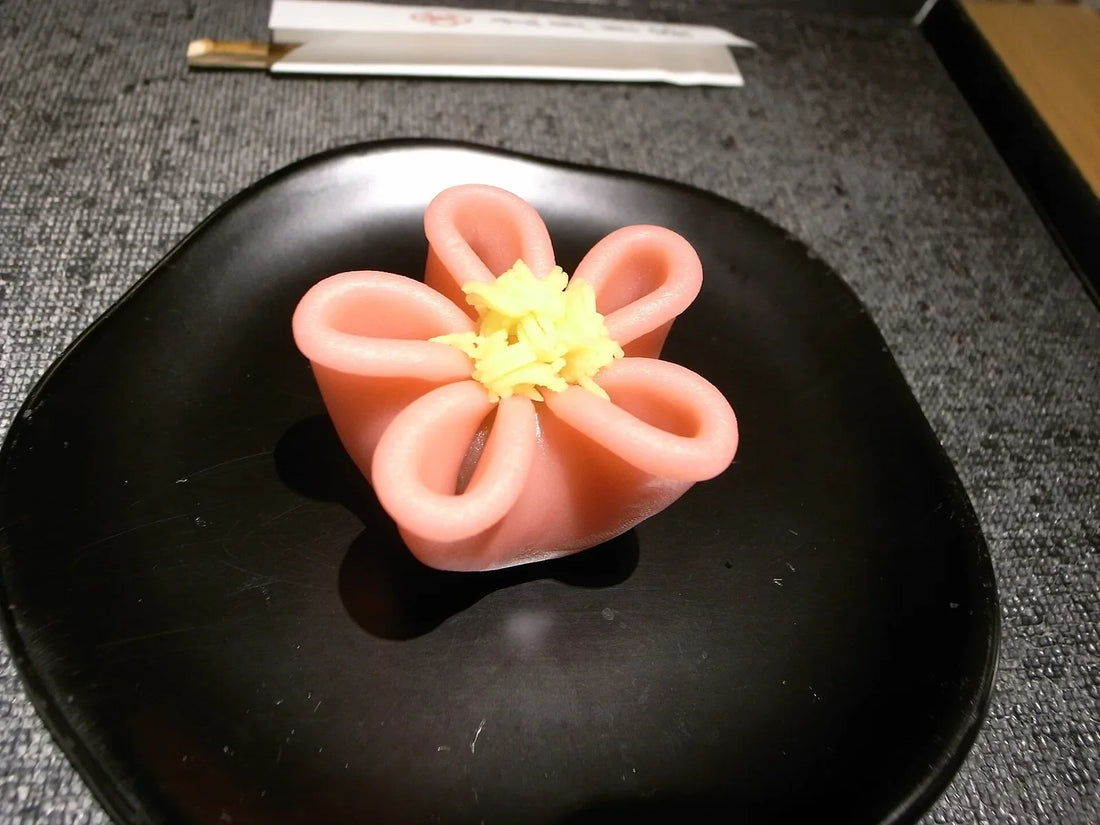
It came on a small plate beside a bowl of matcha, with a little wooden pick to eat it with. A pastel flower, its petals scored so finely they looked carved. It seemed too pretty to eat. You ate it anyway, and it was soft, smooth and only faintly sweet, and nobody told you what it was called.
It was most likely nerikiri (練り切り), a Japanese tea sweet whose name means kneaded and cut: sweet bean paste worked into a soft dough and shaped by hand. Find the one you had below. And if you'd like another, where to get nerikiri in Australia names the Melbourne maker who sells it and the Sydney tea room that serves a seasonal sweet with matcha.
Quick answer
- What it isNerikiri: smooth bean paste kneaded with a little yam or soft rice dough, then sculpted by hand into something from the season.
- Why you never saw the wordJapanese shops sell each piece under a name of its own, taken from the season or an old poem, so the label often says nothing about nerikiri.
- Getting one hereNo grocer stocks it, because it's a fresh sweet. MinnieSweets in Melbourne makes it in seasonal sets to order, and Wasei-an in Surry Hills serves a seasonal sweet with matcha. Where to get it
Which one was on your plate
Nerikiri isn't the only Japanese sweet that looks like this at first glance. Four others get mistaken for it, and each is made a different way, so start with the one you had.
-

Nerikiri (練り切り)
Smooth, matte and pastel, sculpted into a flower with fine tool marks
the flower is the season; the same dough makes leaves, fruit and fish
-

Kinton (きんとん)
Fluffy all over, covered in fine strands of bean paste pushed through a sieve
-

Kingyoku (錦玉)
Clear and glassy like a jelly, with something set inside it
a summer sweet of agar, a seaweed jelly, set with sugar
-

Jōyo manjū (薯蕷饅頭)
A plain white bun whose fine, matte skin is made with grated yam
-

Higashi (干菓子)
Small, dry, pressed pieces with a stamped pattern
the dry tea sweet, taken by hand onto a square of paper
What nerikiri is made of
What you ate was mostly bean paste. Nerikiri starts as smooth bean paste, usually from white beans, though red adzuki paste works too. A binder goes in, either a sticky grated yam or gyūhi, a soft dough of sweetened rice flour. The mix is heated and kneaded until it holds a shape. Then it's coloured, wrapped around a centre of more bean paste, and shaped by hand.
The name is the method. Neri is kneading and kiri is cutting: the dough is kneaded hot, then cut into portions to shape. Beyond that there's no fixed recipe, and each shop keeps its own binder. The yam is a sticky mountain yam, by the way, not sweet potato.
The tools are few. A three-sided wooden spatula scores the petals and the veins of a leaf, and fine scissors snip a chrysanthemum's petals one by one. A small change of colour on the same shape is enough to show the season moving on.
What does nerikiri taste like?
Less sweet than it looks. The sweetness is light and clean and builds slowly as you eat, with a mild, earthy taste of beans underneath. The texture is the surprise. It isn't chewy like mochi. It's smooth and dense, closer to a fine, moist clay that melts slowly.
It often gets called Japanese marzipan, and the comparison holds for what it does: a sweet paste you can sculpt into fruit and flowers. It doesn't hold for what it is. Marzipan is ground almonds and sugar. Nerikiri has no nut in it at all. It's beans, sugar and yam or rice flour, and it's much less sweet.
At a formal tea, the moist sweet comes in a lidded box with one kuromoji, a small wooden pick, for each guest. The dry sweets are taken by hand onto folded paper.
Why the label didn't say nerikiri

If you went looking for the name on the label, you probably didn't find this one. A Japanese sweet shop sells each piece under a name of its own, called a kamei, taken from the season or from classical poetry. The case above is labelled piece by piece: yamabuki, a yellow spring flower, mizubashō, a white marsh flower, and four more, under one price card. None of the labels names the dough.
The names are old, and they are the point. Giving each sweet a name became the custom in Kyoto, Japan's old capital, in the late 1600s. The names play on scenes from old poems: kochi, the east wind, or Tatsuta, a river famous for its autumn leaves. In 2022, Japan listed the craft as intangible cultural heritage under exactly that description: fresh sweets that carry a name.
So the flower is not the definition. The flower is the season, and the dough is what makes it nerikiri. The same dough makes a fish or a ripe fruit, and next month the same shop will make something else.
One more name hides behind the flower. In Kyoto and the west of Japan, the same kind of piece is often made from konashi, bean paste mixed with wheat or rice flour, steamed and then kneaded. Nerikiri is kneaded hot with yam or gyūhi instead. The difference is in the dough, not the look. So the flower alone won't tell you which one you had. A Kyoto shop is simply more likely to call it konashi.
Where to get nerikiri in Australia
Nerikiri is a fresh sweet, and none of the Japanese grocers selling online here, JFC, Jun Direct or Umall among them, lists it. The answer is two people rather than a shelf. Checked in September 2026.
-
Melbourne
MinnieSweets
Makes nerikiri by hand, in seasonal sets to order. Delivered across metro Melbourne.
-
Sydney
Wasei-an
A tea room, not a shop. Its monthly tea ceremony workshop serves matcha with a seasonal sweet made for the day.
Minako Asai, who runs MinnieSweets, grew up in Nagoya, in central Japan, and worked in the food hall of one of Japan's largest department stores before starting it in 2018. She makes everything by hand, down to the bean paste, and sells seasonal sets of wagashi, traditional Japanese sweets. The spring set had two nerikiri in it: a cherry blossom flavoured with salted blossom petals, and a folded one on red bean paste. The shop opens for each set in turn, and the site has a mailing list for the next one.
Wasei-an's founder, Wendy Lin, teaches Urasenke, one of the main schools of tea ceremony, and trained in wagashi with Oimatsu, a Kyoto confectioner founded in 1908. Her tea ceremony is the nearest thing here to how you first met nerikiri, though the sweet on the day is the season's choice. Wasei-an has also run nerikiri-making workshops for adults and for children.
If a shop near you makes nerikiri, tell us and we'll add it.
Common questions
What does nerikiri taste like?
Nerikiri tastes lightly and cleanly sweet, with a mild, earthy taste of beans, and it's much less sweet than it looks. The texture is smooth and dense rather than chewy, closer to a fine, moist clay that melts slowly than to mochi. The flavour comes from the bean paste, sometimes with matcha, cherry blossom or yuzu, a Japanese citrus, added.
What is the difference between nerikiri and wagashi?
Wagashi is the whole family of traditional Japanese sweets, and nerikiri is one kind of it. It's a fresh sweet of bean paste kneaded with yam or gyūhi, a soft rice dough, and sculpted by hand for the season. Dango, rice dumplings on a skewer, and yokan, a firm bean-paste bar, are wagashi too, and our guide to naming Japanese sweets pictures the rest.
What is the meaning of nerikiri?
Nerikiri (練り切り) means kneaded and cut. The name describes the method: bean paste and a binder are heated and kneaded into a smooth dough, which is then cut into portions and shaped by hand. It names the dough, not the design, so a nerikiri can be a flower, a leaf, a fruit or a fish.
How does nerikiri differ from marzipan?
Both are sweet pastes sculpted into fruit and flowers, but they're made from different things. Marzipan is ground almonds and sugar. Nerikiri is bean paste with sugar and a little yam or rice-flour dough, and it contains no nuts. It's also much less sweet, with a smooth, dense texture that melts slowly.
What food is served at a Japanese tea ceremony?
A Japanese tea ceremony serves sweets with the matcha. The moist sweet might be nerikiri, kinton, a jōyo manjū or a rice-cake sweet, brought in a lidded box with a small wooden pick for each guest. The dry sweets, small pressed pieces called higashi, are taken by hand onto a square of folded paper.
Where this leaves you
The name you were after was nerikiri, and the name on the label belonged to the season. Nerikiri isn't on our shelf: it's a fresh sweet, shaped by hand for the season. The one wagashi we stock is yokan, the firm bean-paste bar that keeps at room temperature, from Kinjo Seika. If you're new to Japanese food altogether, start here.
Sources
- Agency for Cultural Affairs, registration of 菓銘をもつ生菓子(煉切・こなし) (2022): the two doughs defined, the tools, the Kyoto roots and the custom of naming each sweet.
- Toraya Bunko, きんとん秘話 (Zenkoku Meika column No. 218): kinton as a ball of bean paste covered in sieved strands.
- Japanese Wikipedia, 練り切り, 薯蕷饅頭, 琥珀羹 and 干菓子: the binders and the three lookalikes.
- Urasenke, お菓子について: how the moist and dry sweets are served at tea.
- Food in Japan, Nerikiri: taste and texture, and the comparison with marzipan.
- Australian makers, from their own pages: MinnieSweets (the spring wagashi set), Wasei-an (the tea ceremony workshop), and the City of Sydney listing of a Wasei-an nerikiri workshop.
- Australian availability checked September 2026 on the retailers' own online stores: JFC Online, Jun Direct and Umall, among others.
Photographs — all from Wikimedia Commons, used under the licences shown: Top photograph by akira yamada (CC BY-SA 2.0); Nerikiri and Kinton by Douglas Perkins (CC0); Kingyoku by Douglas Perkins (CC0, cropped); Jōyo manjū by 7'o'7 (CC BY-SA 3.0); Higashi by iwaryo (CC BY 2.0); the Tokyo display case by Nesnad (CC BY 4.0).


