
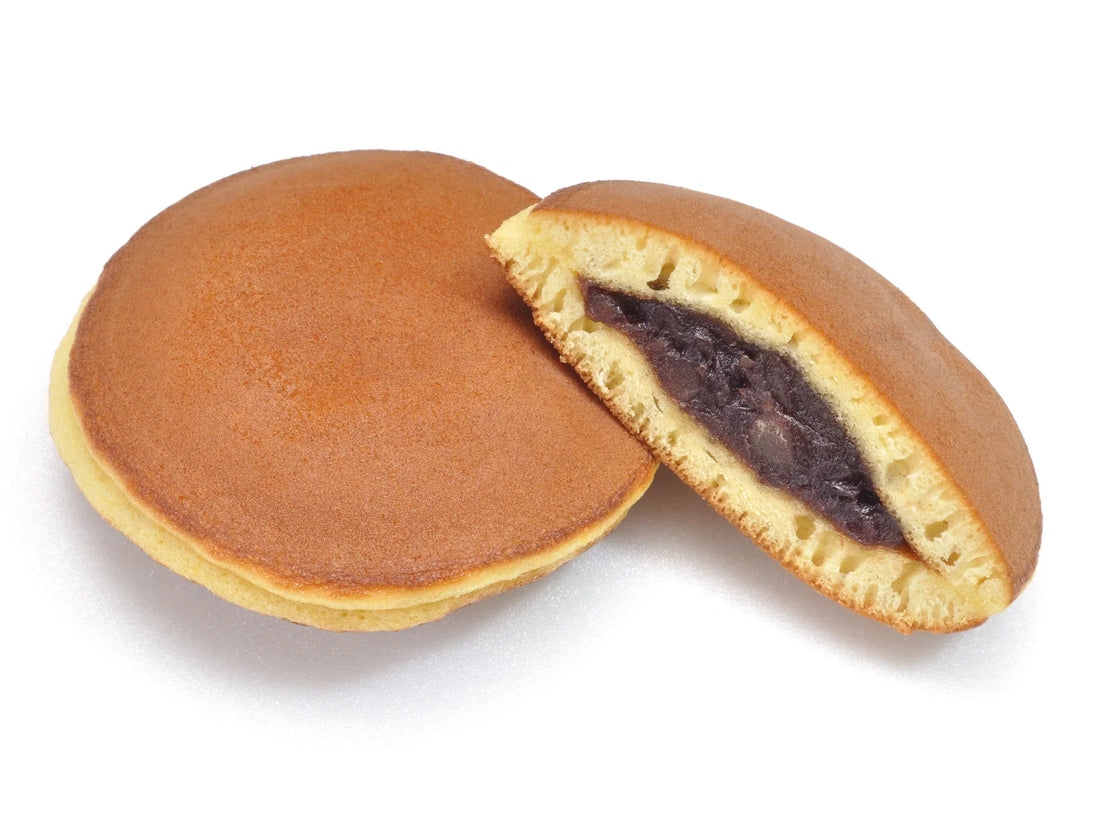
It came out of a wrapper, from a convenience store, a station kiosk, or a supermarket shelf. Two small pancakes, browned and faintly domed, pressed together around something dark and thick. You ate it cold, and it was far better than a cold pancake has any right to be.
The name is dorayaki (どら焼き), and the dark middle is anko, azuki beans boiled with sugar into a thick sweet paste. Below are photographs of every kind you're likely to meet, and of the three sweets people mix it up with. And if you want one in your hand, where to find dorayaki in Australia is unusually good news: this is the one sweet in its family you can buy here without much trouble.
Quick answer
- What it isTwo small pancakes pressed around anko, azuki beans boiled with sugar into a thick sweet paste. Eaten cold, out of a wrapper.
- Not the thick oneImagawayaki is thick and griddled to order, and taiyaki is the fish. Dorayaki is the flat sandwich, cooked in halves and put together after.
- Getting one hereThe easiest of its family to buy here. It keeps at room temperature in the wrapper it left Japan in, so it turns up on an ordinary shelf. Where to buy
Find yours
-

Dorayaki (どら焼き)
Two small browned pancakes pressed around dark paste, sold cold in a wrapper
red bean is the classic, but matcha (powdered green tea), custard and chocolate are normal now
-

Nama-dora (生どら)
Whipped cream through the middle, usually sitting next to the red bean
nama means fresh; this is the one you're most likely to meet in a Japanese convenience store
-

Mochi-iri dorayaki (もち入りどら焼き)
A chewy white lump set inside the paste, stretchy when you pull it apart
that lump is mochi — pounded rice cake, soft and barely sweet on its own
-

Kuri-dora (栗どら)
A whole chestnut sitting in the paste, pale against the dark filling
kuri means chestnut
-

Kuro-dora (黒糖どら焼き)
The cake inside is noticeably darker — brown rather than gold
made with kokutō, an unrefined dark sugar, which is what colours it
-

Nure-dorayaki (ぬれどら焼き)
A thin skin that looks damp rather than fluffy, and clings to the filling
nure means wet; it's made to stay moist instead of drying out
Is dorayaki just a pancake?
No, but the resemblance isn't a coincidence, and that turns out to be the good part.
The skin is built on a formula Japanese confectioners call sandōwari, meaning "three equal parts": flour, egg and sugar in the same measure, with honey or sweet rice wine added for moisture. Shops compete by nudging that ratio. What comes off the griddle is closer to castella, a dense honey-sweetened sponge cake, than to anything you'd pour syrup over at breakfast. It's springy rather than fluffy, and it stays soft for days.
Here's the part almost nobody expects. The skin you eat today was reshaped by Western hotcakes after they arrived in Japan. For a long time the two were genuinely muddled together: into the 1940s and 50s, Japanese writers still treated the dorayaki and the hotcake as versions of one thing. So when you look at one and think that's a pancake, you've not made a beginner's mistake. You've spotted a real piece of its history.
Not the fish one, and not the thick one
If you go searching for dorayaki and keep landing on a fish, this is why. Three Japanese sweets carry the same sweet red bean filling, and only one of them is a dorayaki. The difference is always the outside.
-

Taiyaki (たい焼き)
Shaped like a fish, pressed in a hinged mould, handed to you hot
there's no fish in it — why a fish, and why that fish
-

Imagawayaki (今川焼き)
One thick disc off a hotplate, filling sealed inside, crisp at the rim
many regional names — why that round red bean cake has four names
-

Monaka (最中)
A crisp, dry, papery shell that shatters when you bite it
the shell is baked rice flour, not pancake
The quickest test is temperature. Taiyaki and imagawayaki are handed over hot off a griddle and are stale by evening. A dorayaki is sold cold, in a wrapper, and is meant to be as good tomorrow as it's today. That's not a difference in packaging. It's what dorayaki was invented to do, and it's the reason you can buy this one in Australia.
Why it is called dorayaki
Dora (銅鑼) means gong. Every explanation agrees on that much; what they disagree about is which gong.
The likeliest answer is the plainest one: the sweet is round and slightly domed, like the face of a gong. Japan tells a few other stories about how the name arrived and no one of them has won, but every version involves a gong.
It has also not always looked the way it does now. The dorayaki people bought in the Edo period, roughly the 1600s to the 1860s, was square: a single sheet of batter folded in from the edges, with the red bean left showing in the middle of one face. The two-round-pancake sandwich is the newer idea.
The round shape came first, from a Tokyo shop called Baikatei, in the early Meiji years, the 1870s and 80s. What Baikatei made was a round of red bean paste in a thin baked coat, not yet a sandwich. The two separate pancakes arrived in 1914, at a shop called Usagiya in Ueno, in northern Tokyo. Usagiya had opened the year before, and its first famous product wasn't the dorayaki at all: it was a crisp wafer sweet named after its founder. The dorayaki overtook it, and the queue outside on a weekday morning is still for the dorayaki.
One more name, because you'll meet it. In Kansai, the region around Osaka and Kyoto, the same sweet is often sold as mikasa, after Mount Mikasa, near Nara, the old capital. The two words aren't quite interchangeable, though, and what separates them is how the sweet is built rather than where it's from.
A dorayaki's two pancakes are only pressed together at the rim, so you can still see the seam. A mikasa's are sealed shut, and its skin is thicker. Both came out of that same Tokyo shop, Baikatei, which is the clearest sign that this was never really a regional split. The geography leaks as well: an Osaka maker sells something it calls a five-colour dorayaki.
Is dorayaki from Doraemon?
No, the sweet is far older than the cartoon. What the cartoon changed was the name, in English.
When Doraemon was dubbed into English, the translators didn't keep the word dorayaki. In the dub, the sweet became "Yummy Buns".
The food itself came first by a long way. Doraemon, the robot cat who eats them by the plateful, first appeared in 1969, and dorayaki was an ordinary everyday sweet in Japan long before that.
So if you grew up watching that cartoon, you've known this sweet for years under a name that no shop in Japan has ever used. The real name is the one at the top of this page, and it's what a Japanese menu, packet or shop sign will call it.
Where to find dorayaki in Australia
Here's the good news promised at the top. Most sweets in this family either have to be made here or arrive frozen. Dorayaki does neither. It turns up on an ordinary shelf, at room temperature, in the wrapper it left Japan in.
That's not luck. It was built to solve exactly this problem: the sweets it came from either went hard by evening or had to be eaten hot, so it was made to sit between them. What made it good to carry home makes it good to ship.
Checked in September 2026 on each retailer's own online store. A name is where to look, not a promise it's on the shelf today, and the prices below are a rough guide rather than a quote.
On a shelf
Genki Mart, which has shops around Brisbane and one in Sydney, lists Hiyoshi's dorayaki in red bean and matcha. Snack Affair lists Marukyo's matcha dorayaki alongside a Hiroshima-made one. Umall carries the category too, from Shoseika and Hiyoshi Seika among others, though stock moves. A pack of five or six usually runs around $6 to $12, depending on the maker and the filling, so a dollar or two each.
The cream-filled one is the exception. Cream has to be kept cold, so it doesn't travel. What reaches Australian shelves is the keeping kind: red bean, matcha, chestnut. Worth knowing if the cream one is what you remember.
That dorayaki exports at all is largely down to Marukyo Seika, of Yonago on Japan's west coast. It says its main plant turns out more dorayaki than any other single factory in the world, and ships to more than twenty countries.
Over a counter
And unlike almost everything else in this family, you can get one made in front of you. Over a counter, expect to pay roughly $5 to $7 each.
-
Sydney
Fujimi Bakehouse
A dorayaki specialist, griddled to order: red bean, Nutella, chunky peanut, sweet potato and custard.
-
Melbourne
Torori
An Osaka chain's Melbourne shop, where the dorayaki is filled with matcha tiramisu cream and a slice of warabimochi, a soft jelly-like cake made from bracken starch.
-
Brisbane
Fluffy Soufflé
A soufflé pancake shop that also griddles dorayaki: red bean, and an Oreo cheese one.
That's four counters across three cities. If there's one near you that's not on this list, tell us where and we'll go and check it.
Common questions
What is dorayaki made of?
Dorayaki is made of two small pancakes and a filling. The pancakes use flour, egg and sugar in roughly equal parts, sweetened with honey, which makes them springy and moist rather than fluffy. The filling is almost always anko: azuki beans boiled with sugar into a thick, dark, mildly sweet paste.
What does dorayaki taste like?
Dorayaki tastes mildly sweet and faintly honeyed, with a soft, springy, cake-like skin. The red bean filling is earthy and gently sweet rather than sugary, and it doesn't taste like beans in the savoury sense. Eaten cold, it's more like a sponge cake than a pancake.
Is dorayaki eaten hot or cold?
Dorayaki is normally eaten cold, straight out of the wrapper. It's baked to keep, which is why it's sold packaged in supermarkets and convenience stores rather than hot off a griddle. The Japanese version of that shop is a world of its own, and our guide to the Japanese convenience store explains why its food is so much better than ours. Some shops do griddle it to order, and if you're handed one warm that's the exception rather than the rule.
Is dorayaki the same as mikasa?
Nearly. Mikasa is what the same sweet is usually called in Kansai, the region around Osaka and Kyoto. Where confectioners separate the two, they do it by construction rather than region: a mikasa's two skins are joined so they seal together, and its skin is thicker than a dorayaki's.
Is dorayaki vegan?
No. Dorayaki isn't vegan, because egg is one of the three main ingredients in the skin, and honey is usually added as well. The red bean filling on its own is normally just azuki beans and sugar, but the pancakes around it aren't, so check rather than assume.
Where this leaves you
The word to use in a shop is the one at the top of this page, and the filling to ask about is anko. If the one you remember had cream in it, say nama-dora and you'll be understood.
We carry one sweet from this family, and it sits at the far end of it: yokan, three Kinjo Seika bars of firm red bean jelly that keep at room temperature. Dorayaki keeps because of the way it's baked. Yokan keeps because of the way it's made. And if the pancake was only one of the sweets you could not name, our guide to naming Japanese sweets sorts the rest by what they look like. If the whole category is new to you, start here.
Sources
- Japanese Wikipedia, どら焼き — the equal-parts batter formula, the four gong accounts and how each is graded, the square Edo-period form, and the Kansai mikasa usage.
- National Diet Library, Reference Cooperative Database — dorayaki and mikasa, citing Wagashi no jiten (1983), Kashi: yurai to ajiwaikata (1957), Kashi shin shokuhin jiten (1991) and Tabemono kigen jiten (2013) — the construction difference between the two.
- National Diet Library Digital Collections, Gekkan shokudōraku 2(13), November 1906 — a Tokyo confectioner explaining what dorayaki was made to improve on.
- Tokyo Shimbun, on Usagiya and Tokyo's three great dorayaki — the 1913 founding, and dorayaki's standing as an everyday sweet.
- Anime News Network, Viz Opens English Doraemon Site with Dubbed Trailer — dorayaki renamed "Yummy Buns" for the English dub.
- Marukyo Seika, company profile — the Yonago plant and its export range.
- Broadsheet, on Torori in Melbourne. Australian availability checked September 2026 on the retailers' own online stores — Genki Mart, Snack Affair, Umall and Asian Pantry.
Photographs — all from Wikimedia Commons, used under the licences shown: Top photograph by Ocdp (CC0); Dorayaki by Ocdp (CC BY-SA 3.0); Nama-dora by Kyu3a (CC BY-SA 4.0); Mochi-iri dorayaki by Evelyn-rose (CC0); Kuri-dora by KKPCW (CC BY-SA 4.0); Kuro-dora by Fuchu (CC BY-SA 4.0); Nure-dorayaki by 島児鹿 (CC BY-SA 4.0); Taiyaki by Ocdp (CC0); Imagawayaki by Ocdp (CC0); Monaka by nyanya (CC BY-SA 3.0).


