
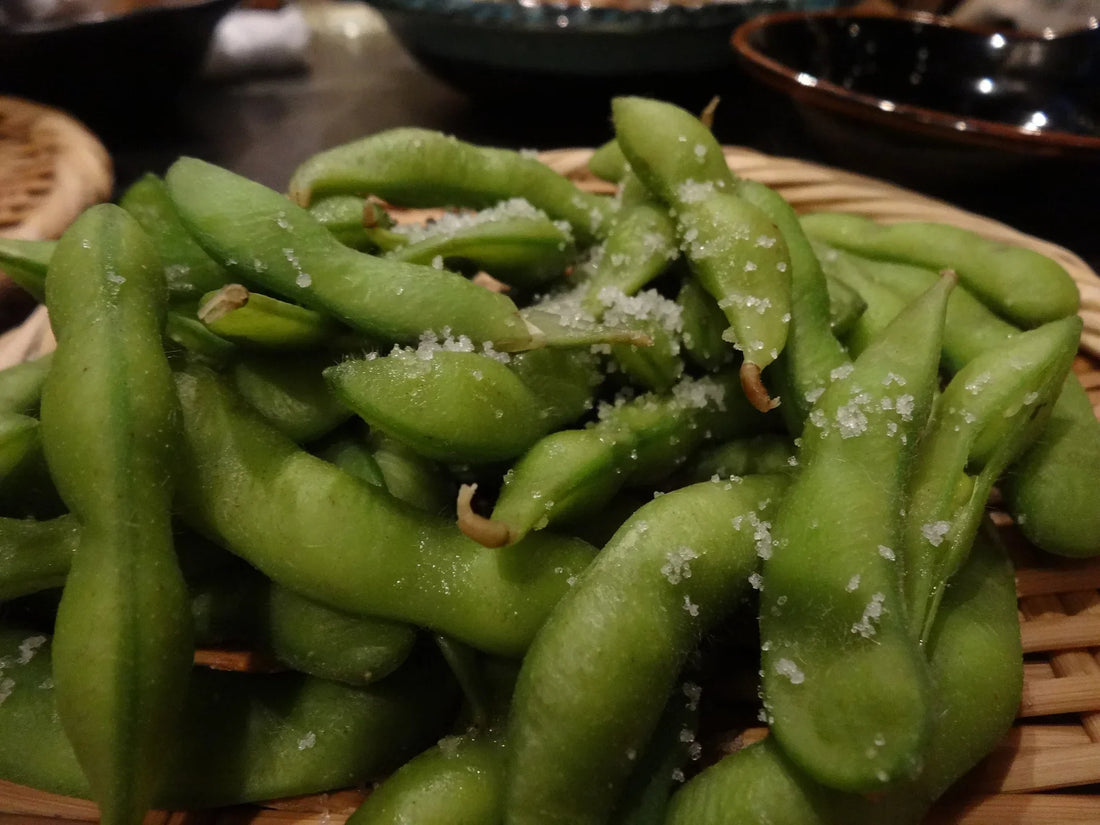
You ordered a beer in Japan and a small dish arrived that you never asked for. Or you're standing in a Japanese grocer here, in front of a shelf of little bags with a squid on the front, working out which of them is a snack and which is dinner.
The word for all of it is otsumami, food you eat with a drink. It's not a dish and not a course. It's a job, and almost anything can hold it.
Below are seven you'll actually meet, what each one looks like, and where to buy them in Australia, including the one that's hard to find here.
Quick answer
- What it isFood eaten with a drink. Not a dish and not a course, but a job, and almost anything can hold it.
- The dish you did not orderThe small plate that arrives with your first drink is otoshi, and in most izakaya it carries a small per-person charge on the bill.
- Buying it hereMost of this list is genuinely easy to get here. Kaki no tane, the rice-cracker mix, is the easy one and several grocers carry it. Where to buy
What otsumami actually means
The Japanese dictionary defines otsumami (おつまみ) twice over, and both halves matter. It's food you can eat with your fingers, and it's simple. The word comes from tsumamu, to pinch or pick something up. The o- on the front is only politeness, the same o- that turns cha into ocha. Tsumami and otsumami are the same word.
So the category is set by the drink, not by the food. A bag of rice crackers is otsumami. So is a saucer of cold tofu. What the two share is that you're drinking, and this is what you're eating while you do.
There's no rulebook about which snack goes with which drink, but there are habits. Edamame with a cold beer is the standard pairing, common enough that a soybean was bred for it. Dried squid and the salty preserved things lean towards sake and shochu, and sake is sometimes drunk with a little salt on the rim of the cup instead of any snack at all.
-

Kaki no tane 柿の種
Small orange-brown rice crackers, curved like a comma, with a low chilli heat.
The name means "persimmon seed": the shape copies one. The plain bag, no peanuts.
-

Kaki-pi 柿ピー
The same orange crackers, with whole pale peanuts mixed through them.
The default bag in Japan. Pi is "peanut"; a 2019 public vote set it at seven crackers to three.
-

Atarime あたりめ · surume するめ
Pale, dry, chewy strips of squid, torn rather than sliced.
Two names, one food. Which one is on the bag is a small superstition — see below.
-

Edamame 枝豆
Bright green fuzzy pods, boiled and salted; you squeeze the beans straight out.
The dictionary's own example of the word. Nagaoka has a soybean called sakana-mame — the drinking-snack bean.
-

Ajitsuke menma 味付けメンマ
Pale tan strips of fermented bamboo shoot in a savoury dressing, from a jar.
The same thing that sits on a bowl of ramen. Ajitsuke means "seasoned".
-

Itawasa 板わさ
Pink-rimmed white fish cake, sliced thin and fanned out with wasabi.
Ita is the board the fish cake is set on, wasa from wasabi. Buy kamaboko and slice it yourself.
-

Tako-wasa たこわさ
Small glossy pieces of raw octopus in a pale green wasabi dressing.
Tako is octopus. Sharp, cold and salty, and the hardest one here to buy in Australia.
Why edamame counts and karaage barely does
There's a bigger word sitting above otsumami, and knowing it settles most of the confusion. That word is sakana (肴), anything at all that goes with a drink. It's built from saka, drink, and na, side dish.
Otsumami is the smaller circle inside it, and it's the circle you're standing in when you pick up a bag. Because the dictionary says otsumami must be pinch-able and simple, edamame lands right in the middle of it. Fried chicken doesn't. Karaage is certainly sakana, and every izakaya, a Japanese pub, serves it. But it's cooked to order and eaten with chopsticks, so it sits at the edge of the smaller word.
Kansai, the region around Osaka and Kyoto, has a third word for much the same thing: ate. That one leans towards small plates and salty delicacies rather than a bag off a shelf.
A word a gambler would not say
Dried squid is sold under two names, and they're the same food. The older one is surume. The problem is the first part of it, suru, which is also the verb for losing money, the sound a gambler doesn't want at the table. So from the middle of the Edo period, the 1700s, the word was swapped for atari, which means to hit or to win. That gives atarime.
There's a second thing hiding on that bag. The word means a different squid depending on where in Japan you are. In the east it's a red one, sold with the skin on. In the west it's a white one with a black tip. They come from different fishing grounds, so a wholesaler will ask a customer which of the two they mean.
Kaki no tane carries a smaller story. A maker in Nagaoka, in Niigata on the coast north-west of Tokyo, flattened his cracker mould by accident in 1923 and sold the odd-shaped result as "persimmon seeds" from 1925. He never trademarked the name, so today every company makes them.
The part that is not food at all
Sakana has a second meaning, and it's the one that shows what this whole category is really organised around. Sakana can be the entertainment at a drinking party. A song, a dance, a party piece, a good piece of gossip. Japanese has the phrase sake no sakana ni suru, to make something the sakana of the drink. It means to make it the thing everyone enjoys over a glass. There's even a word for a dance performed that way.
Once you know that, the category stops being a food group. It's whatever makes the drinking better, and food is only the usual answer.
The same word has one more turn in it. Today sakana is also the ordinary Japanese word for fish: the animal, on a plate or in the sea.
That fish meaning is the newer of the two, and the gap is enormous. The drinking sense is written down from around 717. The fish sense doesn't appear until the early 1600s, and it only pushed the older words for fish out of everyday Japanese after the 1860s. So the word didn't start as "fish" and stretch to cover snacks. It started as "the thing you eat with a drink", and fish took the name because fish was so often that thing.
What we stock, and what we do not
We should be straight about this: none of the seven above are ours. We carry the crisp-and-stick end of the otsumami shelf and none of the dried seafood end: Calbee's thick-cut kataage chips in black pepper, lightly salted and Kansai dashi soy, Pizza Potato, Jagarico sticks, and the savoury Pretz. The black pepper one is the closest thing we sell to a beer snack.
If you want kaki no tane or atarime, the shops below are where to go. If you want the chips, they're on our Japanese potato chips shelf, and Start Here is where to begin if this is all new.
Where to buy otsumami in Australia
Most of this list is genuinely easy to get here. The list below was checked in September 2026. Prices are a rough guide rather than a quote.
Kaki no tane is the easy one. Jun Direct and Genki Mart both carry the Kameda bags, plain and in wasabi and sour plum, and Ichiba Junction stocks the version with peanuts. A 100 g bag runs about $3 to $4, and a six-pack of small bags around $7.
Dried squid is better stocked than you'd expect. Jun Direct carries a whole line of it: atarime strips, shredded surume, soft smoked squid, even squid with cheese. JFC Online and Snack Affair both carry roasted cuttlefish. A small 24 g to 40 g pack runs roughly $4.50 to $6, which is dear by weight and is meant to be. You eat it slowly.
Menma comes in a jar at Jun Direct and Genki Mart, about $3.50 to $4. For itawasa you want kamaboko, the pink-rimmed fish cake, which JFC Online carries in several sizes.
Edamame is in the supermarket. Coles carries frozen pods, ready-to-eat beans and a dry-roasted version, alongside wasabi peas. A 400 g bag is roughly $2.50 to $4 whether you buy it at Coles or a Japanese grocer.
Tako-wasa is the one to give up on for now. Of the six Japanese online grocers here, only JFC Online lists it, and only in a one-kilogram catering tub. There's no home-sized pack. The same goes for shiokara, the salt-fermented squid, and for cheese kamaboko sticks: neither turned up anywhere under any spelling.
If you'd rather walk in and look:
-
Melbourne
Ichiba Junction
Lists rice crackers by name on its own site. Six sites across three states; this is one.
-
Sydney
Ume-Ya
A Japanese grocer with a snack aisle.
One thing worth knowing before you plan a trip: the dedicated Japanese bottle shops here don't sell the snacks. All three of them sell drinks and nothing to eat. In Australia the drink and the otsumami come from different shops. In Japan one shop sells both, which is part of what our guide to the Japanese konbini is about.
Is there an otsumami you met in Japan and can't find here? Tell us what it looked like and we'll go looking.
Common questions
What does otsumami mean in Japanese?
Otsumami means food eaten with a drink. It comes from the verb tsumamu, to pinch or pick up with your fingers, and the dictionary adds that it should be simple. It's a category rather than a dish, so rice crackers, dried squid and cold tofu are all otsumami.
What is the difference between otsumami and sakana?
Sakana is the wider word for anything that accompanies a drink, and otsumami is the smaller, casual part of it. Otsumami has to be pinch-able and simple. Sakana can be a full cooked dish, and it can even be a song or a story rather than food at all.
Is the small dish that arrives with your first drink free?
Usually not. That dish is otoshi, and in most izakaya it comes with a small per-person charge that appears on the bill. It's not universal, though. Several large chains, including Torikizoku and Watami, serve no otoshi and charge nothing for one.
What do Japanese people actually buy as otsumami?
Less dried squid than the classic lists suggest. One convenience-store chain's own receipt data for late 2025 put mixed nuts at the top of the category, ahead of pork ear, dried sweet potato sticks and hand-torn pickled plum. Cheese-and-squid came sixth.
Where this leaves you
The word to carry into a shop is otsumami, and the thing to remember about it is that it names a job rather than a dish. Anything that makes the drink better counts, which is why one list runs from salted beans to dried squid to a bag of rice crackers.
If you're starting, kaki no tane is the bag to reach for and it's in almost every Japanese grocer here. Buy atarime small and eat it slowly; it's dear by weight on purpose. And if the squid is what you came for, either name will do, because surume and atarime are the same bag.
Sources
- 肴 — 精選版 日本国語大辞典 · 世界大百科事典 · 字通 (kotobank) — the 717–724 attestation, the entertainment sense, and the shift of sakana to mean fish
- つまみ — デジタル大辞泉 (weblio) — the definition that bounds otsumami as hand-eaten and simple
- お通し — 日本大百科全書 (kotobank) — what otoshi is, and the east–west naming
- 柿の種 — Japanese Wikipedia — the 1923 mould, the 1925 launch, and the 2019 ratio vote
- なるみ物産, citing 全国いか加工業協同組合 — the east–west squid split, from the trade
- 全国珍味商工業協同組合連合会 — the trade body's definition of chinmi, Japan's salty preserved delicacies
- FeliCa Networks ID receipt data, Lawson, Sep–Nov 2025 — the category ranking
Images: top photograph by inazakira (CC BY-SA 2.0); kaki no tane by Ocdp (CC0 1.0); kaki-pi by Amagase (CC BY-SA 2.5); atarime by Aney (CC BY-SA 3.0); edamame by Kanko* (CC BY 2.0); menma by DryPot (CC BY-SA 3.0); itawasa by Hajime NAKANO (CC BY 2.0); tako-wasa by Lombroso (CC BY-SA 4.0). All via Wikimedia Commons.


