
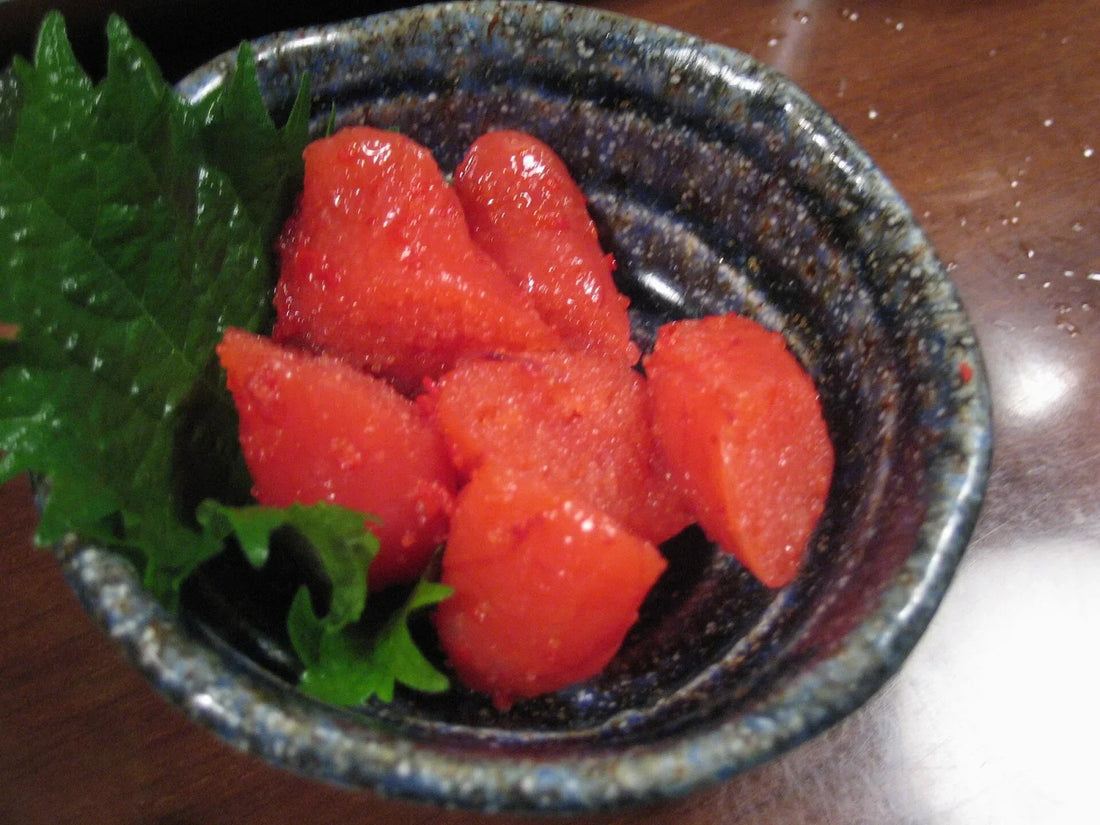
It was pink, speckled with tiny grains, and it came on something you'd ordered: a creamy spaghetti, a rice ball, a slice of seared salmon on a sushi train. The menu called it mentai or mentaiko. Nobody said what that was, whether it was raw, or which fish it came from.
It's mentaiko (明太子, literally pollock roe): the egg sacs of Alaska pollock, a smaller relative of cod, salted and then steeped in a chilli marinade. Find the way you had it below. And if you want it again, where to get mentaiko in Australia names the grocers that keep it frozen and the Sydney shop that puts it in a rice ball.
Quick answer
- What it isMentaiko: the whole egg sac of Alaska pollock, salted, then marinated in chilli. It's cured, not cooked, and eaten as it is.
- Its milder twinTarako is the same roe salted without the chilli. It's paler, and it's what the original Japanese roe spaghetti used.
- Getting it hereJapanese grocers keep the roe frozen, including packs from Fukuya, the shop in Fukuoka, south-west Japan, where today's mentaiko began. Pasta-sauce sachets ship anywhere, and Otogo in Sydney makes a mentaiko rice ball. Where to get it
Which one did you have?
Mentaiko turns up whole, sliced, crumbled and stirred into sauce, so it rarely looks the same twice. Start with the one you ate.
-

Karashi mentaiko (辛子明太子, chilli pollock roe)
Two slim sacs, orange-red, with a fine grain under a thin skin
also sold sliced, or squeezed from a tube
-

Tarako (たらこ, salted pollock roe)
The same pair of sacs, pinker and with no chilli
-

Mentaiko on rice (明太丼, mentai-don; don means rice bowl)
Crumbled red roe over rice, often under shredded seaweed
how Japan eats it most
-

Mentaiko spaghetti
Creamy spaghetti speckled with roe, seaweed strips on top
tarako spaghetti is the milder original
-

Grilled mentaiko (焼き明太子, yaki mentaiko; yaki means grilled)
Thick slices, browned on the outside, soft in the middle
a drinking snack at an izakaya, a Japanese pub
-

Mentaiko udon (udon, thick wheat noodles)
A dollop of roe on the noodles, beside grated white radish
If yours was a pink sauce torched onto seared salmon, that's mentai mayo: mentaiko stirred into mayonnaise, though each kitchen makes its own.
Not mentaiko: the roe it gets mistaken for
If none of those looked right, you may have had a different roe. These five are the ones people confuse with it.
-

Myeongnan-jeot (명란젓, Korean pollock roe)
A deep red sac under sesame and spring onion
the Korean dish mentaiko came from
-

Tobiko or masago (とびこ, flying fish roe)
Tiny loose orange beads coating a roll, crunchy
masago is capelin roe, used the same way
-

Ikura (いくら, salmon roe)
Big glossy orange pearls that pop one at a time
-

Shirako (白子, cod milt)
Soft white folds, like a small cloud
milt from the male fish, not roe
-

Taramasalata
A smooth pink dip with no grains you can see
a Greek dip made from fish roe
What mentaiko is made of
Mentaiko is roe still in its sac. Each piece is one of the pair of ovaries from an Alaska pollock, packed with eggs so small they look like a fine grain. That's why it looks speckled rather than beaded.
It's made in two steps. First the roe is salted, which turns it into tarako. Then the tarako is steeped in a liquid of chilli and seasonings such as dashi, a Japanese stock. Japan's labelling code sets that as the definition of karashi mentaiko, the chilli kind: pollock ovary, seasoned in a chilli-based liquid. It's cured and marinated, not cooked, and in Japan it's eaten just as it is, most often on a bowl of plain rice.
It tastes salty and savoury, with a mild chilli heat, and the tiny grains pop very faintly against your tongue. Tarako tastes the same without the heat.
The name is a clue to where it came from. Mentai comes from myeongtae, the Korean word for pollock, and ko means roe. So the word on your menu says pollock roe, in a borrowed word.
How a Korean side dish became Fukuoka's
The original is Korean. Myeongnan-jeot is pollock roe with chilli sprinkled over it.
Kawahara Toshio grew up with it. He was born in Busan, a port city in the south of Korea, while Japan ruled it, and moved to Japan after the Second World War. In October 1948 he opened a food shop called Fukuya in Nakasu, in Hakata, the heart of the city of Fukuoka in south-west Japan. He changed one thing about the dish he remembered: instead of dusting the roe with chilli, he steeped it in a seasoned liquid. On 10 January 1949 he started making and selling his version.
He never registered the name as a trademark or patented the method. He gave the recipe to other makers instead, and specialist mentaiko makers in Fukuoka Prefecture are said to number in the hundreds today. When the bullet train reached Hakata in 1975, travellers carried it home as a souvenir, and it spread across Japan.
The pasta you may have had came from somewhere else entirely. Kabe no Ana (the hole in the wall) is a spaghetti house in Shibuya, Tokyo. A horn player from the NHK Symphony Orchestra, the orchestra of Japan's public broadcaster, once brought caviar there and asked for it on his spaghetti. The kitchen made it with tarako instead, and that was the start of tarako spaghetti. Mentaiko spaghetti is the spicier version of the same dish.
Is mentaiko spicy cod roe? Not quite
That's the English on almost every pack here, and neither word holds up once you look closely.
The fish. Alaska pollock is in the cod family, but it isn't the big cod you buy as fillets. That cod's roe is rarely made into tarako in Japan: it's too large to take up the seasoning, dark, and quick to spoil. So cod roe on a pack means pollock roe. The name mentaiko itself means pollock roe.
The spice. On a Japanese pack, 明太子 on its own can mean plain tarako as well as the chilli kind. The chilli is only certain when it says 辛子明太子, karashi mentaiko, with karashi meaning chilli-hot.
The colour. Pollock roe is naturally anything from off-white to pale pink. An even, bright red can come from a colouring added to even it out. The packs marked 無着色, mu-chakushoku (no colouring added), are paler and vary more in colour, and that's how they're supposed to look. Fukuya's own pack sold in Australia is one of them.
The label. Made in Japan tells you where the roe was seasoned, not where the fish swam. Japanese packs have to name where the roe itself came from, in brackets after the word pollock: Russia or the United States, for example. And not everything tagged mentaiko is pollock roe at all: one frozen product at an Australian grocer is capelin roe in a mentaiko paste.
Where to get mentaiko in Australia
Everything below was checked in September 2026. Prices are a rough guide, not a quote.
To eat it without cooking anything, Otogo, an onigiri (rice ball) shop in Sydney, has a mentaiko rice ball on its menu at both of its shops.
-
Sydney
Otogo, Town Hall
Japanese rice balls, with mentaiko among the fillings.
-
Sydney
Otogo, Ultimo
The same menu at Otogo's second shop.
The roe itself, frozen. Ichiba Junction, a Japanese grocer with shops in New South Wales, Queensland, Victoria and South Australia, keeps Fukuya's karashi mentaiko and a Fukuya tarako, plus packs from Yamaya. They're frozen and sold for pick-up in store, not posted. JFC Online also sells frozen karashi mentaiko and mentaiko in tubes, and Alaskan Crab Co sells frozen mentaiko and tarako. A small frozen pack runs roughly $8 to $15.
The easy way in. Mentaiko and tarako pasta sauces also come in shelf-stable sachets, so there's no freezer to find. Jun Direct stocks S&B and Ma-Ma's, and Genki Mart stocks Kewpie's. A sachet for two plates is about $3 to $6.
From us. The one mentaiko thing we sell is an instant yakisoba (Japanese fried noodles), Ippei-chan Soy Butter Mentaiko. The mentaiko is in the topping and a squeeze of mentaiko mayo, and it's milder than the name suggests: it's a noodle cup with a hint of roe, not the roe itself.
If you know a restaurant here that serves mentaiko, tell us and we'll add it.
Common questions
What exactly is mentaiko made of?
Mentaiko is made of the roe of Alaska pollock, still inside its sac, first salted and then marinated in a liquid of chilli and seasonings. Japan's labelling code defines it that way: pollock ovary seasoned in a chilli-based liquid. Nothing else goes into the sac itself, though some makers add colouring.
What does mentaiko taste like?
Mentaiko tastes salty and savoury, with a mild chilli heat that builds slowly, and the tiny eggs pop very faintly on the tongue. Stirred into a hot sauce it turns soft and creamy. Tarako, the same roe without chilli, tastes the same but milder, and it's the roe in the original Japanese spaghetti.
What are tarako and mentaiko?
Tarako and mentaiko are both Alaska pollock roe, kept whole in the sac. Tarako is only salted. Mentaiko, or karashi mentaiko in full, is tarako steeped afterwards in a chilli marinade, so it's redder and spicier. On a Japanese pack, 明太子 alone can mean either, so look for 辛子 if you want the chilli.
What is mentai sauce made of?
Mentai sauce, or mentai mayo, is mentaiko mixed into mayonnaise, and in Japan it's sold ready-made as well as made fresh. It's what goes on seared salmon, fries and toast. A restaurant's own version can vary, so if the roe matters to you, ask what's in theirs.
What is cod sperm?
Cod sperm usually means shirako, the milt of the male cod: soft, white and folded, and served in Japan on sushi, among other ways. It isn't mentaiko. Mentaiko comes from the female fish and is roe, the eggs, in a pink or red sac, so the two look nothing alike.
Where this leaves you
The pink thing was mentaiko: pollock roe, cured in chilli, and a Korean dish by way of Hakata. If you want the flavour without hunting for a freezer, our one mentaiko product lives with the other Japanese yakisoba. If you're new to Japanese food altogether, start here.
Sources
- 全国辛子めんたいこ食品公正取引協議会 (the karashi mentaiko fair trade council), labelling code and Q&A: the definition, the origin line and the example of Russia or the United States.
- Fukuya, 会社沿革 (company history): founded October 1948 in Nakasu, first mentaiko sold 10 January 1949.
- ACROS Fukuoka, 博多っ子列伝 川原俊夫 (a profile of Kawahara Toshio): Kawahara's Busan childhood, the Korean original, and the recipe he never patented.
- たらこ食堂 (Fukuya group), 着色料 (colourings): the natural colour of pollock roe, and why some packs are coloured.
- 壁の穴 (Kabe no Ana), introduction: the Shibuya spaghetti house and the tarako that stood in for caviar.
- Kikkoman, Tarako and Mentaiko: the two roes and how they taste; Japanese Wikipedia, たらこ: why true cod roe isn't used.
- Availability checked September 2026 on the sellers' own pages: Ichiba Junction, JFC Online, Alaskan Crab Co, Jun Direct, Genki Mart and Otogo's menu.
Photographs — all from Wikimedia Commons, used under the licences shown: Top photograph by ayustety (CC BY-SA 2.0); Karashi mentaiko by Ocdp (CC0); Tarako by yuko_photonote (CC BY 2.0); Mentaiko on rice by Masahiko OHKUBO (CC BY 2.0); Mentaiko spaghetti by Kumiko Korezumi (CC0); Grilled mentaiko by ayustety (CC BY-SA 2.0); Mentaiko udon by Kyu3a (CC BY-SA 4.0); Myeongnan-jeot by ayustety (CC BY-SA 2.0); Tobiko by Tim Reckmann (CC BY 2.0); Ikura by Blue Lotus (CC BY 2.0); Shirako by Arashiyama (CC BY-SA 3.0); Taramasalata by Robert Kindermann (CC BY-SA 2.5).
