
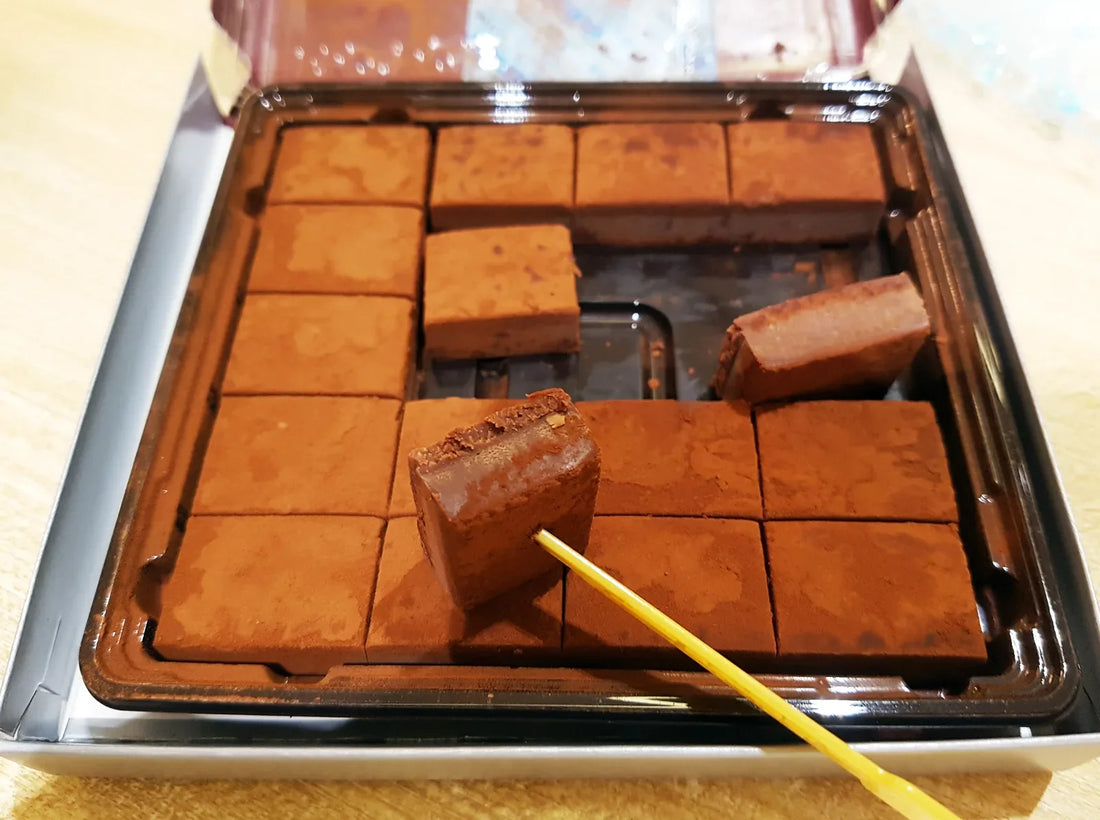
You had them in Japan, or somebody brought a box home: small dark squares, dusted in cocoa, kept in the fridge, soft enough to give way under your thumb. They were gone before anyone said what they were called. They were nama chocolate, 生チョコレート on the box.
Then you went looking for a nama choco recipe, and it asked for three bars of chocolate. Not 150 grams. Three bars. That isn't sloppy writing, it's how Japanese home recipes are written, and it's a clue to what the stuff is. Here's what nama chocolate actually is, how the people who make it write the method, and where to buy it in Australia if you would rather someone else did the work.
Quick answer
- What it isGanache, a truffle's soft centre, set in a tray, cut into squares, no shell. Japan's labelling rule: at least a tenth of its weight cream, at least a tenth water, so it yields, not snaps.
- How it's madeMeiji, Lotte and Morinaga build it on their own supermarket bar: two parts chocolate to one of cream, an hour to set.
- Getting it hereA Melbourne maker, a frozen cake and shelf version at the Japanese grocers, no ordinary route for the chilled box from ROYCE' in Hokkaido, Japan's north. Where to get it
What nama chocolate actually is
It's ganache. The soft, dark, cream-and-chocolate centre you find inside a truffle, made in a tray and cut into squares instead of being rolled and coated. The shop that gave the style its name puts it exactly that way. Sils Maria, in Hiratsuka, an hour southwest of Tokyo, says a truffle is ganache with a shell around the outside, and that nama chocolate is the same soft interior with the shell deliberately left off.

That softness isn't a style choice, it's a requirement. In Japan a chocolate can't be sold as nama chocolate unless two things are true: at least a tenth of its weight is cream, and at least a tenth of its weight is water. Ordinary chocolate has almost no water in it. Put a tenth of the weight back as cream and it stops snapping and starts giving way under your thumb. ROYCE', the maker on Hokkaido, Japan's northern island, that most Australians have met, runs its own to roughly 17 or 18 per cent water.
The one it gets confused with is Meiji's Meltykiss, which is cocoa-dusted, soft, and sold in a winter box. It's a supermarket chocolate rather than a chocolatier's, and it doesn't meet the nama standard.

How Japan's chocolate makers write the recipe
Three of the big Japanese chocolate companies publish a nama chocolate recipe of their own: Meiji, Lotte and Morinaga. That matters, because it tells you what to buy. None asks for couverture or a cacao percentage. Each asks for its own supermarket eating bar.
And each one counts in bars. Meiji's calls for five bars of its milk chocolate, then puts 250 g in brackets after it. Lotte's asks for three bars of Ghana Milk, brackets 150 g. The bar is the unit a Japanese cook measures in, and the grams are the translation, not the other way round.
But the bar is not a fixed weight. Meiji's and Lotte's are 50 g each, which is where "three bars, 150 grams" comes from. Morinaga's recipe counts boxes of DARS instead, for a plain reason: it stopped making its 50 g bars, so it no longer has one to count. Read the brackets, not the bar.
| Meiji | Lotte | Morinaga | |
|---|---|---|---|
| Chocolate | 5 bars of Meiji Milk Chocolate | 3 bars of Ghana Milk | 2 boxes of DARS Milk |
| Chocolate weight | 250 g | 150 g | 90 g |
| Cream | 100 cc | 80 cc | 48 g |
| Sets in | Freezer, 1 hour | Fridge, 1 hour or more | Fridge, 1 hour |
The ratio is the other surprise. Ganache has a reputation for being equal parts chocolate and cream. Set the chocolate against the cream in each recipe and all three come out closer to two parts chocolate to one part cream. That is firmer and more chocolate-heavy than the word suggests, and it is what lets you cut it into squares and pick one up.
The method is short. Heat the cream to just under the boil, pour it over finely chopped chocolate, and leave it alone until the steam stops before you stir. Whisk it smooth, pour it into a lined tray, level it, and chill it until it sets. Turn it out, trim the edges with a warmed knife, cut, and dust cocoa over the top and the bottom through a tea strainer.
One detail worth copying. Meiji's recipe sets its tray in the freezer for an hour; Lotte and Morinaga use the fridge for the same hour. The freezer here is a setting step, not storage. Nama chocolate is a fresh-cream product, it lives in the fridge, and every one of those makers says so on the recipe itself, along with how long to give it.
Nama is a rule, not a translation
If you have looked this up, you have been told that nama means raw. That is the one sense it never carries here. Nothing in it is uncooked: the cream is heated and the chocolate is melted. The word "raw" is attached to it only because somebody once had to put an English word next to 生. Here that character is doing the job of the rule above: it tells a shopper the box holds something soft and chilled rather than something snappy.
The same character does a different job three doors down. On beer it means unpasteurised, and Japan's beer labelling code bars the word from any beer that has been heat-treated. On cream, 生クリーム, it means the cream holds nothing but milk fat. On caramel, 生キャラメル, it only describes a soft, creamy style: no labelling code covers caramel, so there is no rule to fail. Nama chocolate sits with the beer and the cream.
Where to get it in Australia
Everything below was checked in September 2026. Prices are a rough guide, not a quote.
-
Melbourne
Mamé Cocoa
Makes nama chocolate here, in nine flavours from matcha and houjicha to yuzu, black sesame and Japanese whisky. Around thirty dollars a box, ordered online.
Japanese grocers carry the imported kind, in two forms. Ichiba Junction stocks a frozen nama chocolate cake, collection only because it can't survive a courier, with instructions to move it to the fridge the night before. The same shop carries a sakura-flavoured soft cream chocolate from Furuta on the ordinary shelf, for under ten dollars. Umall lists a plainer cocoa-dusted Japanese nama chocolate from Takaoka in the same bracket, though it has been out of stock lately.
The chilled ROYCE' box is the one with no ordinary route. ROYCE' does not count Australia among the countries it operates in, and it ships everything out of its Hokkaido factory refrigerated. Neither Ichiba Junction nor Umall carries it, and the listings that do turn up on Australian sites were already past the date printed on the box. If you want that particular box, somebody has to hand-carry it.
If you're making it, the bar is the easy part. Meiji's recipe names its own two bars, and we stock both: Meiji Milk Chocolate 50g for the standard version, and Meiji Black Chocolate 50g if you want it darker. The rest is cream and an hour.
Common questions
What is nama chocolate?
Nama chocolate is chocolate ganache sold without a coating: chocolate and fresh cream set together in a tray, cut into squares and dusted with cocoa. In Japan it has to be at least a tenth cream and at least a tenth water by weight, which is what makes it soft enough to collapse rather than snap.
How is nama chocolate made?
Cream is heated to just below boiling and poured over finely chopped chocolate, left until the steam stops, then whisked smooth. The mixture goes into a lined tray, chills for about an hour until firm, and is turned out, trimmed with a warmed knife, cut into squares and dusted with cocoa on both sides.
What makes nama chocolate so special?
The water. Ordinary chocolate has almost none; nama chocolate is at least a tenth cream and a tenth water, so it gives way instead of breaking. That is a defined standard in Japan rather than a marketing word, and it is also why the stuff has to stay in the fridge rather than sitting in a cupboard.
Can you make nama chocolate with normal chocolate?
Yes, and that is what the Japanese makers tell you to do. Meiji, Lotte and Morinaga all write their nama chocolate recipes around their own supermarket eating bars rather than couverture. Use about two parts chocolate to one part cream, and read the gram weight rather than assuming every bar is 50 g.
If you make a tray of it, or you have found it on a shelf somewhere in Australia we have missed, tell us and we will add it. Otherwise the rest of the shelf is through Japanese Chocolate, and if you are new to any of this, start here.
Sources
- 農林水産省 消費者の部屋 — chocolate naming and the cacao minimums
- 全国チョコレート業公正取引協議会 — the chocolate labelling code
- 明治 — 基本の生チョコ, the maker's own recipe
- ロッテ — ガーナ 生チョコ, the Ghana-bar nama recipe
- 森永製菓 — 生チョコ and its note on the discontinued bars
- シルスマリア — how the name began
- ROYCE' — ロイズの秘密, on water content and 1995
Photographs: box of nama chocolate by Bitterschoko (CC0); ganache squares by sirooziya (CC BY-SA 3.0); Meltykiss cubes by Miyuki Meinaka (CC BY-SA 4.0), all via Wikimedia Commons.

