



Product information
About
This is a packet of ramen you cook in a saucepan, not a cup you pour water into. Three servings, each a dried noodle cake and a sachet of miso soup, and the broth is a pork-and-miso one lifted with garlic and ginger: sweet, savoury and deep rather than sharp. Raoh is Nissin's premium bagged line.
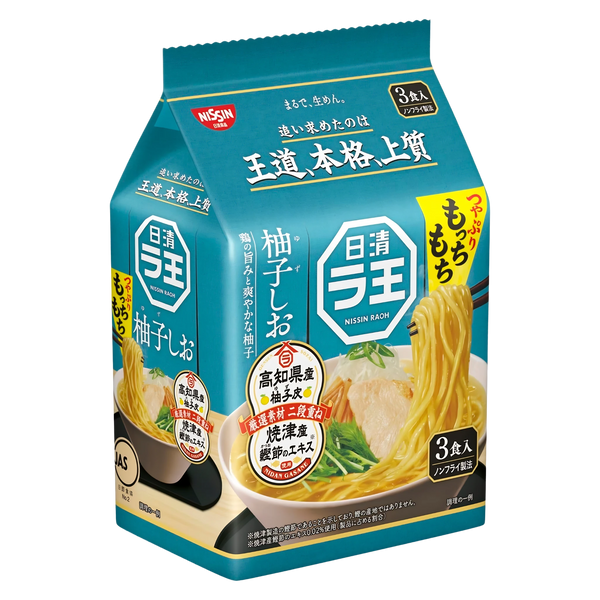
On the pack: 日清ラ王 味噌.
If you have seen "Raoh" in a supermarket, that is a different pack. Woolworths ranges a Raoh-branded five-pack of single-serve noodles; the retailers listing it give its country of origin as Vietnam, and the packaging is printed for another market. This is the Japanese-market pack: made in Japan, three larger servings rather than five small ones. Same brand and the same logo, genuinely different product.
What you're getting
- The noodle is the reason this line exists. It is non-fried, so it eats closer to a fresh noodle than a packet one usually does. It is thick, flat, smooth and dense, and everyone agrees on that much. Where people split is whether it eats like a ramen shop's noodle or a bit too neat and machine-made. You will know within one bowl which camp you're in.
- The soup is a Hokkaido rice-koji miso, koji being the cultured rice that ferments the paste, with a Kagoshima Berkshire-pork extract. It is a pork-based broth.
- The most common complaint is that the broth is light. Worth knowing that the noodle and the soup tend to divide people separately: very few dislike both, so if one of the two is not for you the other may still be.
- Three servings in the bag, cooked one at a time. Nothing comes with it, no dried vegetables, no meat, no garnish. The bag is sold bare so you top it however you like.
- One serving carries close to a whole day's worth of salt by the World Health Organization's guideline: every flavour in this range is in the same territory, and most of it is in the broth. Worth knowing before you drink the bowl dry.
- Allergens: contains wheat, egg, milk, sesame and soy. Egg and milk are declared on the pack but are not in the ingredient list, so our ingredients panel does not show them, on those two, trust the allergen list. Read the pack's own label before you rely on ours.
The one thing to get right: do not pour the cooking water away. You boil the noodles in a measured 450 ml, then tip that water into your bowl over the soup sachet and add the noodles last, the water is the broth. This is the opposite of the yakisoba trays we also sell, where draining is the whole method, so it is an easy habit to bring to the wrong product. There is no colander involved and nothing goes down the sink.
A few more things worth knowing. The soup sachet is a liquid, and it goes into the empty bowl first, never into the pan. The 450 ml is a measured amount rather than "a pot of water": the ratio is the seasoning. And the pack is the Japanese-market one, so the method is set out in full above, in English.
Ingredients
The maker's ingredient list, translated from the Japanese pack. Anything after the break is an additive — the Japanese label lists those separately.
Noodles (wheat flour (milled in Japan), salt, vegetable oil, chicken seasoning); soup (miso, soy sauce, pork extract, lard, sugars, seasoned pork oil, seasoned onion oil, salt, ginger seasoning, yeast extract, garlic seasoning, vegetable oil, spices, seasoned miso oil, pepper seasoning, soy dietary fibre)
modified starch, flavour enhancer (amino acids etc.), kansui (alkaline noodle salts), calcium phosphate, caramel colour, flavouring, antioxidants (vitamin C, vitamin E), carotenoid colour, acidity regulator, spice extract, vitamin B2, vitamin B1, emulsifier.
The printed label on the pack is always the authority on ingredients and allergens, not this page — please read it in full before you rely on our summary. If you are unsure about an ingredient, contact us.
Allergens
The maker declares:
- Allergens
-
- Wheat
- Egg
- Milk
- Sesame
- Soy
The printed label on the pack is always the authority on ingredients and allergens, not this page — please read it in full before you rely on our summary. If you are unsure about an ingredient, contact us.
Details
- Maker
- Nissin
- Made in
- Japan
- Net contents
- One bag: 276 g, three servings, of which 219 g is noodles
Our guide
How to eat it
- Bring 450 ml of water to a full boil in a saucepan and cook one noodle cake for about four minutes, biting a strand near the end and taking it off when it is as firm as you like. Meanwhile put the soup sachet into your empty bowl: never into the pan, and never boil it.
- When the noodles have loosened, pour the hot water from the pan into the bowl FIRST and stir the soup through it. The noodles go in last. Nothing is drained away: that cooking water is your broth.
Good to know
- Measure the 450 ml rather than guessing. The ratio is the seasoning, and eyeballing it is the difference between a broth and a thin one.
- Nothing comes in the bag, so decide the toppings before you start. Butter and tinned corn is the Hokkaido convention on a miso bowl and both are supermarket staples; bean sprouts, spring onion, a soft-boiled egg or leftover roast pork all work.
- If the noodle is firmer than you like at four minutes, give it another minute or two. Store the bag at room temperature, out of direct sun and away from anything strongly scented.
In their own words
What Japanese buyers say
What do the numbers mean?
Counts of how many reviews mentioned each thing, not a score. One review can mention several. Every quote is our translation, with the original Japanese beneath it.
- What they like
Mellow miso, and the noodle's bite is so firm you wouldn't believe it's a bagged noodle.
芳醇な味噌味、麺の歯応えも袋麺と思えないぐらいしっかり美味しい!
from monolog
- What they like
It was shop-level good ramen.
お店レベルの美味しいラーメンでした。
from monolog
- What they grumble about
Dense, supple, very elastic, a mochi-textured noodle with real presence — but so uniformly engineered it feels slightly monotonous.
緻密でしなやかで、粘りも強く、モッチリした存在感の高い麺だが、均質に整いすぎていてやや単調な気もする。
Our tip: This is the fault line, and we would rather show it than hide it. Everyone describes the noodle the same way; what they disagree about is whether that is a compliment.
- What they like
Slippery and springy — a refinement of taste and mouthfeel other ramen don't have.
ツルツルシコシコ 他のラーメンにない上品な味と麺の口触り
from monolog
- What they like
The noodle is a thick, mochi-chewy one and it's delicious.
麺はもちもちの太麺で美味しい。
from monolog
- What they like
The rice-koji miso in the soup was sweet and really good.
スープも米麹味噌が甘くてとても美味しかった。
from monolog
- What they grumble about
It's somehow too slippery, and the noodle itself tastes underwhelming.
なんかつるつるし過ぎてるし 麺の味が物足りない~な
from monolog
- What they like
The noodle has body, and the miso soup has dashi depth and richness.
麺にコシがあるしお味噌のスープも出汁が効いてコクがあり美味しいです。
from monolog
- What they like
A noodle you can't believe is instant, and the soup was genuinely delicious.
インスタント思えない麺で、スープもホントに美味しかったです。
from monolog
- What they like
The miso is strong and tastes like the miso hotpot base I always use — familiar and delicious.
味噌が濃くて、いつも食べてる市販の味噌鍋の素の味に似てるので、親しみやすく美味しい!
from monolog
- What they grumble about
The noodle wasn't for me — flat-ish, bad texture, doesn't slip down, oddly heavy.
麺が口に合いませんでした🥴 平たいような麺が食感悪いしするっともいかない変に重たい
from monolog
- What they like
Load it with vegetables and meat like a hotpot, and finish with the ramen!
鍋料理みたいに野菜と肉とたくさんいれて、最後にラーメン!
from monolog
- What they like
Added pork and cabbage, then butter, crumbled nori and chilli flakes at the end — lovely.
豚肉とキャベツを入れて、最後にバターともみのり、一味唐辛子で美味しくいただきました
from monolog
- What they like
Adding a tin of mackerel in water made it superb.
サバの水煮缶を入れたら最高においしかったです。
from monolog
- What they grumble about
Made it exactly as directed, but the flavour is thin.
レシピ通りに作ったけど 味が薄い。
mentioned in 4 of 60 reviews we readfrom monolog
- What they like
At the stated time the noodle is still firm, so I prefer 1–2 minutes longer.
指定時間ではまだ固めの麺なので、1〜2分ほど長めが好み。
from monolog
Real quotes from Japanese review sites, translated by us. We show no star rating from those sites.
The maker
Where it comes from
- Nissin
Raoh started in 1992 as Japan's first shelf-stable "fresh-style" cup ramen: a soft noodle in a pouch rather than a dried block. Nissin discontinued it in August 2010, then relaunched the brand weeks later on a new non-fried noodle: steamed and dried rather than flash-fried, built in three layers with durum flour through the inner one. Nissin had been selling Raoh in bags since 1997; the current bagged series arrived in 2012.
The whole brand is an answer to one question: whether a packet noodle can eat like a ramen shop's. Every generation of it has been another attempt at the same thing, and the noodle is where the effort goes.
Product facts here are checked against the maker's own page: nissin.com (opens in a new tab)
Often bought together
-

Nissin Raoh Miso Ramen Packet — Japanese Non-Fried Noodles, 3 Servings, 276g
$8.80
You are on this one
