



Product information
About
This is a packet of ramen you cook in a saucepan, not a cup you pour water into. Three servings, each a dried noodle cake and a sachet of soup, and the broth is soy-led with pork richness through it and a real hit of garlic. Raoh is Nissin's premium bagged line, and this flavour carries the thickest noodle in the range.
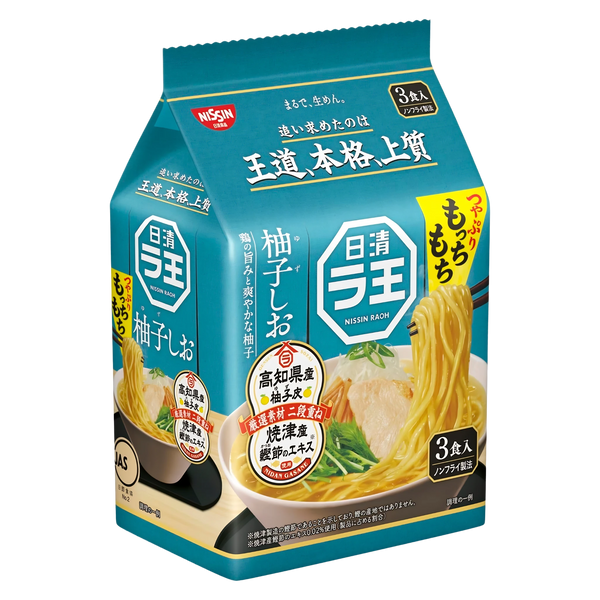
On the pack: 日清ラ王 豚骨醤油.
If you have seen "Raoh" in a supermarket, that is a different pack. Woolworths ranges a Raoh-branded five-pack of single-serve noodles; the retailers listing it give its country of origin as Vietnam, and the packaging is printed for another market. This is the Japanese-market pack: made in Japan, three larger servings rather than five small ones. Same brand and the same logo, genuinely different product.
What you're getting
- It is not the tonkotsu you are picturing. If "tonkotsu" makes you think of the thick, opaque, milk-white Hakata bowl, this is a different thing: the first ingredient in the soup is soy sauce, and there is no pork-bone extract in it at all. What it has is pork fat and pork extract in a soy broth, with garlic. It tastes like iekei: the Yokohama style, soy-based and garlicky, rather than anything from Hakata.
- The noodle is non-fried, so it eats closer to a fresh noodle than a packet one usually does. It is the thickest and straightest of the Raoh bags we stock: firm bite, springy, slippery.
- Two things go into it: a Kagoshima Berkshire-pork extract and an Aomori garlic paste.
- Three servings in the bag. Nothing comes with it, no dried vegetables, no meat, no garnish. Nissin's own instructions suggest chāshū (braised pork belly, or any leftover roast pork), spinach, spring onion and nori seaweed, which is a useful shopping list.
- The honest one: it will make your kitchen smell, and it lingers. It is a garlicky pork broth doing what a garlicky pork broth does, worth knowing before you cook it in a flat with the bedroom door open.
- One serving carries near a whole day's worth of salt by the World Health Organization's guideline, and most of it is in the broth.
- Allergens: contains wheat, egg, milk, sesame and soy. Egg and milk are declared on the pack but are not in the ingredient list, so our ingredients panel does not show them, on those two, trust the allergen list. Read the pack's own label before you rely on ours.
The one thing to get right: do not pour the cooking water away. You boil the noodles in a measured 450 ml, then tip that water into your bowl over the soup sachet and add the noodles last, the water is the broth. This is the opposite of the yakisoba trays we also sell, where draining is the whole method. There is no colander and nothing goes down the sink.
Two more things. This flavour cooks for five minutes, not four: a minute longer than the miso and tantanmen bags, because the noodle is thicker. Going by another Raoh's timing will undercook it. And the pack is the Japanese-market one, so the method is set out in full above, in English.
Ingredients
The maker's ingredient list, translated from the Japanese pack. Anything after the break is an additive — the Japanese label lists those separately.
Noodles (wheat flour (milled in Japan), salt, vegetable oil, chicken seasoning); soup (soy sauce, lard, pork extract, sugars, hydrolysed protein, garlic seasoning, seasoned garlic oil, salt, seasoned pork oil, garlic, yeast powder)
modified starch, flavour enhancer (amino acids etc.), kansui (alkaline noodle salts), calcium phosphate, caramel colour, flavouring, carotenoid colour, spice extract, thickener (xanthan gum), acidity regulator, antioxidant (vitamin E), vitamin B2, vitamin B1.
The printed label on the pack is always the authority on ingredients and allergens, not this page — please read it in full before you rely on our summary. If you are unsure about an ingredient, contact us.
Allergens
The maker declares:
- Allergens
-
- Wheat
- Egg
- Milk
- Sesame
- Soy
The printed label on the pack is always the authority on ingredients and allergens, not this page — please read it in full before you rely on our summary. If you are unsure about an ingredient, contact us.
Details
- Maker
- Nissin
- Made in
- Japan
- Net contents
- One bag: 279 g, three servings, of which 219 g is noodles
Our guide
How to eat it
- Bring 450 ml of water to a full boil in a saucepan and cook one noodle cake for about five minutes: a minute longer than the other Raoh flavours, because this noodle is thicker. Bite a strand near the end and take it off when it is as firm as you like. Meanwhile put the soup sachet into your empty bowl; never into the pan, and never boil it.
- When the noodles have loosened, pour the hot water from the pan into the bowl FIRST and stir the soup through it. The noodles go in last. Nothing is drained away: that cooking water is your broth.
Good to know
- Nissin's own instructions name the toppings: char siu, spinach, spring onion and nori. Spinach, spring onion and nori are ordinary supermarket items; leftover roast pork stands in for the char siu perfectly well.
- Measure the 450 ml rather than guessing. The ratio is the seasoning, and eyeballing it is the difference between a broth and a thin one.
- Store the bag at room temperature, out of direct sun and away from anything strongly scented. Expect the kitchen to smell of it for a while afterwards.
In their own words
What Japanese buyers say
- What they like
Both noodles and broth were shop-standard!
麺もスープもお店並でした!
- What they grumble about
The noodle was flat. The tonkotsu-shoyu broth was delicious. You do need to get toppings ready.
麺は平麺でした。豚骨醤油スープは美味しかったです。具材の用意が必要ですね。
from monolog
Our tip: Nothing comes in the bag — no dried vegetables, no meat. Worth deciding the toppings before you start rather than halfway through the four minutes.
- What they like
The rich broth was delicious. I think it's the best in this series.
濃厚スープが、おいしかった。このシリーズで一番おいしいと思う。
- What they like
It doesn't have much of that tonkotsu funk, and the noodles were slippery-smooth and delicious.
豚骨特有の臭みがそこまでなくて麺もツルツルで美味しかったです
- What they grumble about
After eating it I smelled of tonkotsu shoyu the whole time.
食べてからずっと自分からとんこつ醤油の匂いがしました
- What they like
Not too strong, nicely judged, delicious. The noodles are good too.
濃すぎず程よい味が美味しいです。麺も美味しいです
- What they like
Full marks for substance. I add bean sprouts and char siu.
食べ応え満点。もやしや、チャーシューを足します。
- What they grumble about
The broth's smell is strong. I thought it might be hard to eat, but the taste was delicious.
スープの臭いがきついです。 食べにくいかもと思いましたが、味はおいしかったです。
- What they like
It keeps better than fresh noodles, so it saves me when I'm stuck for a meal. Tastes like fresh noodles.
生麺よりも日持ちがするのでメニューに困った時に助かります。生麺のように美味しいです。
- What they like
Proper pork-bone flavour, delicious. I repeat-bought.
しっかり豚骨の味がしておいしい。リピートしました。
- What they grumble about
The pork-and-soy broth is just right, but the noodle is a bit firm — I think opinions will divide.
豚骨と醤油のスープが丁度良いのですが、麺はやや硬くこのみがわかれると思います
Our tip: The firmness is the point of the range and the thing a minority genuinely dislikes. If you want it softer, another minute in the pan does it.
- What they like
It's instant, but close to fresh noodles and delicious — the broth has a firm flavour too.
インスタントなんですが 生麺に近く 美味しかった スープも 味がしっかりしていて 美味しい
from monolog
- What they like
Perfect for lunch — quick to make, so it's fast and tasty!
昼飯にピッタリ、サクッと作れるので時短でうまい!
from monolog
- What they grumble about
I had hopes, but the taste is bad. The noodle is thick. Disappointing.
期待したけど、味が悪い。麺が太い。残念。
- What they like
Bought it for emergency stock. The date isn't that long, so I'll rolling-stock it and keep checking.
備蓄用に買いました。期限がそんなに長くないので確認しながらローリングストックしていくつもりです。
from monolog
Real quotes from Japanese review sites, translated by us. We show no star rating from those sites.
The maker
Where it comes from
- Nissin
Raoh started in 1992 as Japan's first shelf-stable "fresh-style" cup ramen: a soft noodle in a pouch rather than a dried block. Nissin discontinued it in August 2010, then relaunched the brand three weeks later on a new non-fried noodle: steamed and dried rather than flash-fried, built in three layers with durum flour through the inner one. The bagged version followed in 2012.
The whole brand is an answer to one question: whether a packet noodle can eat like a ramen shop's. Every generation of it has been another attempt at the same thing, and the noodle is where the effort goes.
Product facts here are checked against the maker's own page: nissin.com (opens in a new tab)
Often bought together
-

Nissin Raoh Tonkotsu Shoyu Ramen Packet — Pork & Soy Broth, 3 Servings, 279g
$8.80
You are on this one
