
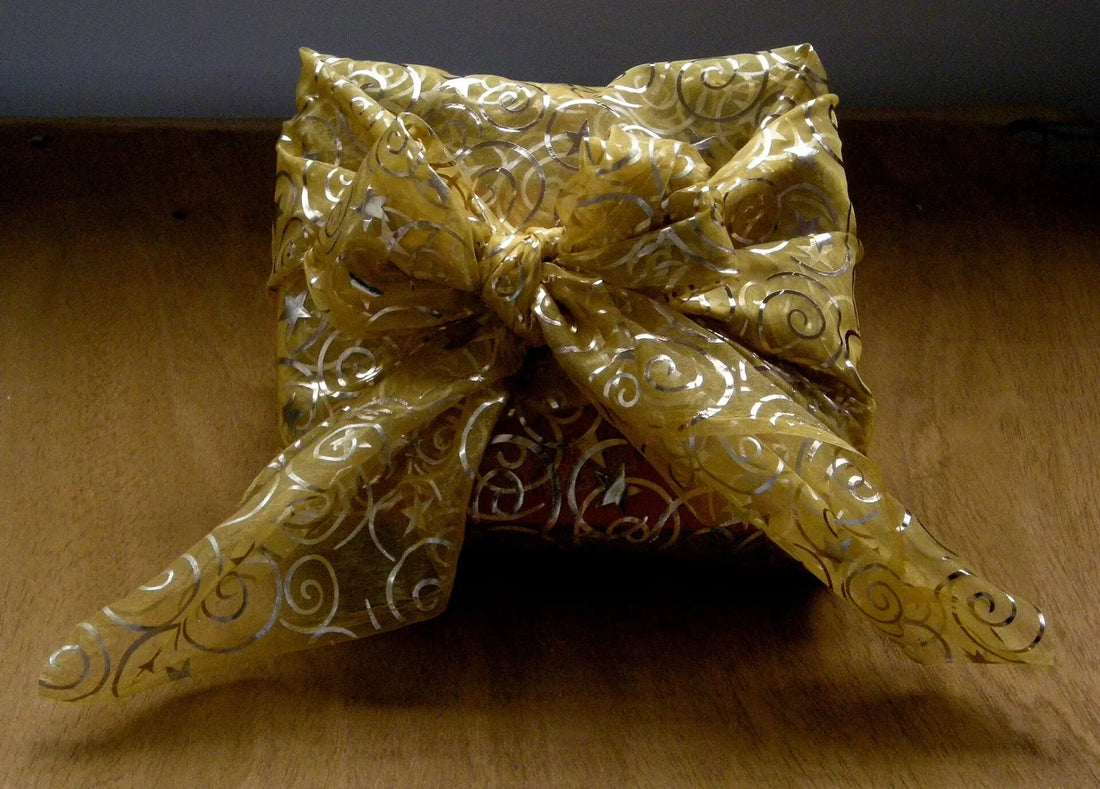
You're looking for gifts for someone who loves Japan, or for someone who's Japanese: a host family, a colleague, a friend's new partner. Either way you're looking at a shelf of lucky cats and green tea, wondering what actually lands, and whether there's a rule you're about to break.
A gift is okurimono (贈り物) in Japanese, and the good news is that the ones that work are easy to find here. Below are the gifts that suit someone who loves Japan, what each one says to someone Japanese, the few customs that still hold, and where to buy Japanese gifts in Australia, shop by shop.
Quick answer
- What to giveWell-made everyday things: a furoshiki wrapping cloth, good chopsticks, Japanese porcelain, matcha, a box of rice crackers to share, or a daruma, the lucky wishing doll.
- The customs that holdSkip sets of four, knives or glass at a wedding, a potted plant for someone who's ill, and shoes or a watch for a boss. Take the gift out of its bag to hand it over.
- Buying it hereJapanese homeware and craft shops in Sydney, Melbourne and Adelaide carry nearly all of it, and they sell online too. Where to buy
Which Japanese gift fits?
Start with the person, then find the card. Each one says what the thing is and, where it matters, what it means in Japan.
-

Furoshiki (風呂敷, wrapping cloth)
A printed square cloth that wraps the gift, then becomes part of it
kept and reused, so nothing goes in the bin
-

Tenugui (手ぬぐい, cotton hand cloth)
A long, thin printed cotton cloth: hand towel, headband or wall hanging
-

Chopsticks and a rest (箸 hashi, 箸置き hashioki)
A good pair of chopsticks, and a small rest to lay them on
a matched pair for a couple is a Japanese wedding gift
-

Everyday porcelain (Hasami ware, Mino ware: named after where it's made)
Plates and bowls made for daily use, often patterned in blue
give a set of five, not four
-

Matcha (抹茶, powdered green tea)
Bright green tea powder, with a bamboo whisk and a bowl to go with it
-

Sake set (酒器, shuki, ware for sake, Japanese rice wine)
A small flask, the tokkuri, usually sold with little cups
the vessels, for someone who already has a favourite
-

Rice crackers (せんべい, senbei)
Crisp round rice crackers, sold in boxes to share
the easy choice for a host family or an office
-

Daruma (達磨, wishing doll)
A round red doll with blank white eyes
paint in one eye when you set a goal, the other when you reach it
-

Maneki-neko (招き猫, beckoning cat)
A ceramic cat with one paw raised
a charm that invites customers, so a good gift for a new business
-

Fūrin (風鈴, wind chime)
A small glass bell with a paper strip that catches the breeze
-

Incense (お香, okō)
Slim sticks in a paper box, often in several scents
Giving to someone Japanese: which customs still hold?
Most of it is common sense. In Japan the point of a gift is whether the person will enjoy it or use it, and the rules that do hold are tied to a number, an occasion or a boss. They matter when the person is Japanese; a friend who simply loves Japan won't be counting.
Numbers. Four is read shi, which also means death, and nine is read ku, which also means suffering. Nobody wants a gift that sounds like either, so a set of four plates or four pairs of chopsticks is avoided. Odd numbers used to be the lucky ones, so a set of five is the easy answer.
The occasion. Knives and scissors can suggest cutting ties, so they're left out of a wedding or a house move. Glass can suggest breaking, which is also wrong for a wedding, and candles are wrong for a new home. A potted plant is avoided for someone who's ill, because the word for taking root, netsuku, sounds exactly like the word for being bedridden.
Your boss. Shoes and socks are things you tread on, so they're rude to give a superior. A watch or a pen can come across as a hint to work harder.
Handing it over. Take the gift out of its carrier bag first, because the bag is only there to keep the dust off. The old phrase to go with it was tsumaranai mono desu ga, "it's only a small thing". Japanese manners teachers now suggest dropping it, since it can sound like you think the gift is worthless. What they suggest instead is kokoro bakari no shina desu ga, roughly "it's a small token of my feelings".

The cords and the paper. A formal celebratory gift in Japan carries mizuhiki (水引), stiff twisted paper cords, and noshi (熨斗), a small folded paper ornament. Red and white cords are for celebrations, gold and silver for weddings. The knot matters too: a bow can be retied, so it suits happy events that can come again, like a birth, while a knot that can't be undone is kept for a wedding. So if a shop here offers them, red and white with a bow suits a birthday or a new baby.
Is a clock really a bad gift in Japan?
No. That one comes from China: in Chinese, giving a clock sounds like attending a death. In Japan the only caution is a watch for your boss, and that's about working harder, not dying.
Several other famous gift rules bend the same way once you look at Japan itself. A knife is avoided at a wedding, yet it's also given as a lucky charm for cutting open your own future. Tea is one of the standard gifts in Japan's two gift seasons, summer and the end of the year. Only some shop owners avoid it as an opening present, because in old Japanese slang, "grinding tea" meant sitting idle with no customers.
A handkerchief can suggest a parting, but only rarely does anyone take it that way. Even nine was once a lucky number: nine gifts traditionally sealed a betrothal, and it's only today that it suggests suffering. Japan's own etiquette writing calls many gift taboos baseless modern superstitions.
So the rule that matters is the one Japan puts first. Choose something the person will enjoy or use, and a good pair of chopsticks for someone who cooks will beat a box picked only because it breaks no rules.
Where to buy Japanese gifts in Australia
Everything below was checked in September 2026. Japanese homeware and craft shops carry nearly everything on the cards above, and each of these also sells online.
-
Sydney
Simply Native
Japanese tea and tea tools, handmade ceramics, incense, bamboo chopsticks and furoshiki gift wrapping.
-
Sydney
Books Kinokuniya
A Japanese bookshop chain with its own stationery and gifts section.
-
Melbourne
Osara, Collingwood
Japanese tableware including Hasami ware, sake sets, wind chimes, incense and lucky cats.
-
Melbourne
Osara, South Melbourne Market
Osara's stall inside the market.
-
Melbourne
Minimaru
Japanese homeware: furoshiki, tenugui, chopsticks and rests, matcha bowls, daruma. Also at Chadstone.
-
Melbourne
Kurashi Japanese Crafts
Ceramics, woodwork, glass and incense by named Japanese makers.
-
Adelaide
Little Tokyo
Furoshiki, chopsticks and rests, lucky cats and daruma, green tea, and gift wrapping.
Anywhere else, online. Okaeri is an online shop with Kamawanu furoshiki and tenugui, Shino and Hagi ware (two traditional Japanese pottery styles), and incense. Outside Sydney, Melbourne and Adelaide, Okaeri and the shops above post to you.
Sweets to share. Japanese grocers online carry the edible gifts. Premium Co has Akai Bohshi's boxed biscuits, Jun Direct has Yoneya's mini yokan, a firm bean jelly, and Ichiba Junction has rice cracker assortments. Our guide to wagashi, Japan's traditional sweets, explains the sweets themselves.
From us. We sell three Kinjo Seika yokan, and Bourbon's Mt Fuji Alfort, a souvenir box of chocolate biscuits with Mount Fuji moulded into every piece.
Common questions
What is a good gift to give a Japanese person?
A good gift to give a Japanese person is something they'll enjoy or use, in a set that isn't four: good chopsticks, porcelain, quality tea, or an Australian treat such as macadamias or honey. For a host family or an office, a box of sweets or rice crackers to share works well.
What is a traditional Japanese gift?
Traditional Japanese gifts include the furoshiki wrapping cloth, chopsticks, porcelain and lacquer tableware, tea, and lucky charms such as the daruma doll and the maneki-neko cat. Japan also has two gift seasons a year, ochūgen in summer and oseibo at the end of the year, when tea, food and drink are sent.
What are some good Australian gifts for Japanese people?
Good Australian gifts for Japanese people include macadamias, Jarrah or Manuka honey, Koko Black chocolate, Byron Bay Cookies, T2 tea, Australian coffee and Lucas' Papaw Ointment. They're the Australian buys a leading Japanese travel guidebook recommends to its own readers, so they're things people in Japan recognise and want.
A Japanese gift doesn't need to be rare or rule-proof, only chosen for the person. If you'd like to add something Japanese to eat, our Japanese wagashi, the traditional sweets, are a good place to begin, and if you're new to Japanese food altogether, start here. Found a shop we should add? Tell us.
Sources
- nippon.com, 贈答品のタブー: the gift taboos, their readings, and the knife, tea, clock and nine exceptions.
- Japanese Wikipedia, 水引 and 熨斗: the cord colours, the two knots, and noshi's abalone origin.
- National Diet Library reference database, お歳暮の起源: where the year-end gift season comes from.
- All About, 手土産の渡し方: taking the gift out of its bag, and what to say.
- 朝時間.jp, 「つまらないものですが」は使わない?: why the old phrase is being dropped.
- 地球の歩き方, オーストラリアのお土産: the Australian gifts Japanese travellers are told to buy.
- Availability checked September 2026 on the shops' own pages: Simply Native, Kinokuniya, Osara, Minimaru, Kurashi, Little Tokyo, Okaeri, Premium Co, Jun Direct and Ichiba Junction.
Photographs — all from Wikimedia Commons, used under the licences shown: Top photograph by Wolfgang H. Wögerer, Wien, Austria (CC BY-SA 3.0); Furoshiki by katorisi (CC BY 3.0); Tenugui by Rikaris (CC BY-SA 3.0); Chopsticks and a rest by chris 論 (CC BY-SA 3.0); Hasami ware by Nesnad (CC BY 4.0); Matcha by dungthuyvunguyen (CC0); Sake flask by Kentin (CC BY-SA 3.0); Rice crackers by DryPot (CC BY 2.5); Daruma by Crisco 1492 (public domain); Maneki-neko by Su--May (CC BY 2.0); Wind chime by Charity Davenport (CC0); Incense by Jun OHWADA (CC BY 2.0); Mizuhiki by SilverBullet X (CC0).

