
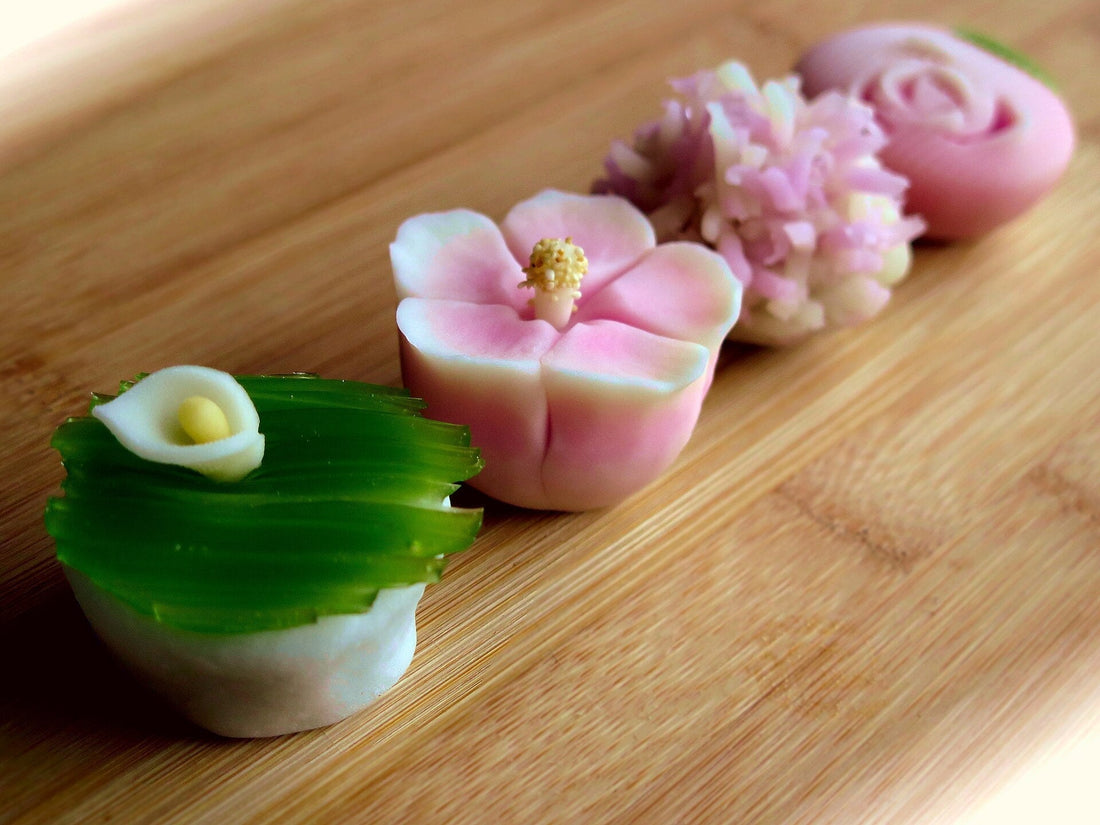
You had it somewhere between the temple and the train station. Soft, faintly sweet, filled with something dark and thick that you assumed was chocolate until you tasted it. You've tried to find it since. The trouble is that you have been searching for a description, and Japan sells it under a name.
Let's start with the name. Almost all of it is wagashi (和菓子), traditional Japanese confectionery, but that's the category, not the word that gets you the right thing in a shop. Find the thing you remember below; the name in bold is what to search for. (That dark filling, in almost every one, is anko, sweetened red bean paste. More below.) And if you want one in your hand, skip to where to find these in Australia: which of these you can buy here, where, and which one is hard to get.
Quick answer
- What it isWagashi is traditional Japanese confectionery, from soft mochi to firm bean-paste jellies. It is the category, not one sweet.
- The dark fillingIn almost every one it is anko, sweetened red bean paste, which is what people take for chocolate until they taste it.
- Getting some hereMore of this is easier to buy here than you would guess. Mochi ice cream is in the supermarkets, the Japanese grocers carry most of the rest, and only monaka, the crisp wafer one, is genuinely hard. Where to find them
Find yours
-

Daifuku (大福)
A soft white ball, dusted with powder, squashy, filled with dark paste
-

Dorayaki (どら焼き)
Two small pancakes sandwiched around the filling
-

Taiyaki (たい焼き)
Shaped like a fish, eaten hot off a griddle
-

Imagawayaki (今川焼き)
A thick round disc off a hotplate, crisp edge, moulded in a circular iron
and about a hundred other names — why that round red bean cake has four names
-

Monaka (最中)
A crisp, papery wafer shell, almost weightless, filled with paste
-

Manju (饅頭)
A small soft bun wrapped around bean paste — usually steamed, sometimes baked
-

Yokan (羊羹)
A firm dark block, sliced into neat rectangles, jelly-like but sturdy
-

Sakuramochi (桜餅)
Pale pink, wrapped in a single pickled leaf
-

Dango (団子)
Three or four chewy dumplings on a skewer, often glazed
glazed in sweet soy is mitarashi dango; the pink-white-green skewer is hanami dango
-

Anpan (あんぱん)
Filled with dark paste, and topped with sesame, poppy seeds or a salted cherry blossom
-

Anmitsu (あんみつ)
A bowl of jelly cubes, fruit and syrup
-

Oshiruko / Zenzai (お汁粉/ぜんざい)
A hot bowl of sweet soup with grilled rice cake floating in it
-

Nerikiri (練り切り)
A small sculpted thing shaped like a flower or a leaf, served with matcha
a kind of namagashi — a fresh sweet, made and eaten the same day
The ones people describe instead of naming
Some are searched for by description so often that the description has become the search. If one of these is what you typed:
- "Japanese fish ice cream": a taiyaki with soft-serve piped into it instead of bean paste. The fish shape is the taiyaki; the ice cream is the modern version, sold from stalls and shopping streets.
- "Fish red bean cake": also taiyaki, in its original form. Batter, fish mould, anko inside.
- "Red bean cake": usually imagawayaki, sometimes dorayaki. Both are batter-and-anko; the first is thick and round, the second is two flat pancakes.
- "Strawberry mochi": ichigo daifuku, a whole strawberry sitting in bean paste, wrapped in mochi. A late-winter and spring thing in Japan.
- "Japanese star candy": konpeitō, the tiny coloured sugar stars. Not wagashi in the strict sense, but it's what people mean.
None of these descriptions are wrong. They are just not what the shop calls it, which is the whole problem this page exists to solve.
The filling is probably what you actually remember
The dark paste running through nearly all of it is anko (餡), azuki beans simmered and sweetened. Not chocolate. Assuming it's chocolate is the most common way this memory goes wrong.
It comes in forms, and shops distinguish them carefully:
- Tsubuan (粒餡): the beans kept whole, skins intact. Texture you can see.
- Koshian (こし餡): pushed through cloth to strain the skins out. Smooth, refined, no grain at all.
Three more turn up on labels. Tsubushian (潰し餡) is mashed with the skins left in. Shiroan (白餡) is made from white beans rather than azuki, and is usually the base for flavoured pastes. Uguisu-an (うぐいす餡) is pale green, made from green peas, and named after the bush warbler.
If you remember it as smooth, you had koshian. If you remember biting through whole beans, tsubuan. Shops will tell you which one they use, and regulars care.
Why you could not find the round one
If the thing you're hunting is the thick disc cooked in a circular iron mould, your search didn't fail because you searched badly. It failed because Japan has no single word for it.
It's imagawayaki in much of the country, ōbanyaki across large parts of it, and kaitenyaki around Osaka and Kobe, and elsewhere simply whatever the local maker called it. There are more than a hundred names for it nationwide, by one linguist's count. When a 2025 survey asked, those same three came out on top at roughly 35%, 27% and 24%, so no name is used by even half the country.
You were searching in good faith for a thing whose own country cannot agree on what to call it.
The names region by region, how it differs from taiyaki and dorayaki, and where to buy one in Australia are in our guide to the round red bean cake.
The pink one with the leaf, and whether to eat it
Sakuramochi comes in two versions that look quite different, and which one you met depends on where you were. The Kantō style (長命寺, after the Tokyo temple) is a thin crepe-like sheet folded around the filling. The Kansai style (道明寺), from around Osaka and Kyoto, is made from coarsely ground glutinous rice, so it's grainy and dumpling-shaped. Both wear a pickled cherry leaf.
On the leaf: the All Japan Confectioners Association recommends leaving it: the sweet tastes better without it. Plenty of people eat it anyway. Preference, not a rule; but if you left it on the plate feeling uncertain, you were doing the orthodox thing.
Why some of it can come home and some cannot
Japanese confectionery is formally classified by moisture content, and that one number explains most of the disappointment with sweets brought home:
- Namagashi (生菓子): above about 30% moisture. Fresh sweets: daifuku, dango, the sculpted tea-ceremony pieces. The National Wagashi Association calls the everyday ones asa-namagashi, made each morning, meant to be eaten that same day.
- Han-namagashi (半生菓子): roughly 10–30%. The middle tier.
- Higashi (干菓子): under about 10%. Dry sweets, pressed sugar, long-keeping.
Yokan is the exception, and the reason is sugar. Firm neri-yokan is set with kanten (agar from seaweed) and carries so much sugar that the sugar itself does the preserving, so it keeps at room temperature without a fridge. That's why it became the classic Japanese souvenir: a sweet that survived the journey home was the one travellers bought, and regional yokan grew up around that from the Meiji period, the late 1800s, onwards. If you did that souvenir shopping in Don Quijote, the late-night discount chain everyone in Japan calls Donki, our guide to Donki covers its tourist floor.
So if you want the flavour of that trip on a shelf, yokan is the honest answer, and it's the one sweet on this page we sell ourselves. Traditional freshly made daifuku was never built to travel: the one you bought at a station had hours in it, not days. The packaged, long-life daifuku sold in Asian supermarkets is a different product, and the easiest of the three to find here.
The word for most of it: wagashi
Most of what's above is wagashi (和菓子), traditional Japanese confectionery. Not quite all of it. Anpan is formally a kashipan (菓子パン), a sweet bread: a European baking technique carrying a Japanese filling. A different trade from a wagashi shop, with identical anko inside. Kimuraya in Ginza built the first one in 1874 and sent a cherry-blossom version to the Meiji Emperor the following spring. Japan still marks 4 April as Anpan Day. Konpeitō sits outside the category too. Everything else on the list is squarely in.
The word is younger than the food by centuries. When Japan opened to the West in the Meiji era, the late 1800s, chocolate, biscuits and cake arrived as yōgashi (洋菓子), Western sweets, which left Japanese confectionery needing a name of its own. Several were tried first, all of them ways of saying “Japanese sweets”: waseigashi (和製菓子), nihongashi (日本菓子), hōka (邦菓). Wagashi is the one that stuck, settling into general use across the late Taishō and early Shōwa periods, roughly the 1920s into the early 1930s.
So the word was invented to describe a contrast, which is why the category feels so broad: it's defined by what it's not. That's also why asking for wagashi at a counter won't get you the sweet you remember: you need the name of the sweet itself.
Where to find these in Australia
More of this is easier to buy here than you'd guess, and only monaka is hard to find. Five tiers, easiest to hardest, then that exception. Every shop named was checked in September 2026 and is linked at the end. A name is where to look, not a promise it's on the shelf today, and any price here's a rough guide rather than a quote.
1. The supermarket one
Mochi ice cream is the only sweet here a mainstream supermarket carries: Coles and Woolworths both stock Little Moons, in six-packs. It's also probably not what you had: the shell is mochi, the filling is ice cream, not anko. A six-pack usually sits around $8 to $11, and it's often on special for less.
2. Packaged and long-life: most of this list
Daifuku, dorayaki, yokan and warabimochi are all built to keep, and Japanese and Asian grocers here carry them routinely.
Jun Pacific has run Japanese groceries in Australia since 1976: Tokyo Mart at Northbridge Plaza in Sydney, Fuji Mart in Melbourne, Brisbane, the Gold Coast and Perth, and Jun Direct shipping Australia-wide. JFC, the Japanese food distributor, sells to the public online; Genki Mart has six shops around Brisbane and one on Kent Street in Sydney; Umall delivers across Sydney.
Between them, expect cream daifuku in strawberry, mango and matcha, plain aka daifuku, which is just red bean inside, dorayaki from Shoseika and Hiyoshi Seika, and yokan from Kinjo Seika and Yoneya. A packaged daifuku pack runs roughly $3.50 to $8, the lower end a mixed-flavour tray and the upper end a single premium flavour like grape or muscat.
Kinjo Seika yokan is also the one sweet on this list we carry ourselves: ogura (smooth red bean), kuri (chestnut) and neri (the pale, firmer one), 130 g bars.
That dorayaki exports at all is largely one company's doing: Marukyo Seika of Yonago runs the world's largest dorayaki factory and built it to ship. Yokan needs no such help: the sweet built to survive the journey home survives the shipping container too. None of it tastes like the fresh one, and all of it is recognisably the right thing.
3. Frozen: the ones said not to travel
Taiyaki, imagawayaki, dango and manju are cooked to order or made that morning in Japan, so the assumption is that they can't leave. Frozen, they can: JFC's frozen range runs to mochi taiyaki, mini taiyaki, imagawayaki with red bean, mitarashi dango and karinto manju. Defrosted isn't hot off a griddle. It's much closer than nothing.
4. Fresh: made here, sold over a counter
The namagashi end of the moisture table exists here too; it has to be made here rather than imported. By city, and every address opens the shop on Google Maps, where its hours are current:
-
Sydney
Fuji Japanese Bakery
A family bakery on the north shore since 1984, and the one entry here that answers anpan: soft rolls stuffed with coarsely mashed azuki, melonpan, and daifuku made fresh.
-
Sydney
Sydney Daifuku Store
A mochi counter inside Commission Coffee. Daifuku made by hand each morning, in store only: original with a whole strawberry, matcha, double chocolate, blueberry, kiwi, and a weekend special. It sells out.
-
Sydney
Azuki Bakery
Japanese-European baking daily, with daifuku on the counter, grape when grapes are in season.
-
Sydney
Fujimi Bakehouse
Dorayaki cooked to order in original, matcha and bamboo batters.
-
Sydney, Melbourne and Perth
Kamakura Warabi-Mochi
The one most people can reach: warabimochi cut by hand in store from bracken starch.
-
Melbourne
Torori
An Osaka warabimochi chain’s first shop here: the mochi set in trays, cut to order and tossed in kinako (roasted soybean flour), matcha or chocolate, with dorayaki griddled alongside.
-
Brisbane
Houbi Ichigo
The nearest thing the city has to a wagashi counter: strawberry mochi, azuki daifuku and warabimochi in a Japanese dessert cafe.
5. Made to order, and the only route to nerikiri
Nothing above sells nerikiri, the sculpted piece served with matcha. No counter we could find here does. Two makers do it by hand instead. MinnieSweets has been making wagashi in Melbourne since 2018: nerikiri and daifuku, everything from scratch down to the bean paste, at markets and festivals and to order online. Wasei-an, Surry Hills, in Sydney, is a tea room rather than a shop: its founder trained in nerikiri at Oimatsu in Kyoto, a confectioner since 1908, and teaches it in bookable workshops. Neither is somewhere you drop into on a Saturday, and both are the real thing.
Adelaide, Canberra and the Gold Coast have Japanese grocers and restaurants, but no fresh wagashi counter that says so on its own menu. The closest on the Gold Coast is CHANOYU, Nerang, which bakes its own matcha cream puffs and tarts: Japanese, but yōgashi rather than wagashi. If we've missed one, tell us.
The exception: monaka
Monaka is the crisp, papery wafer shell filled with bean paste. Monaka ice cream is easy, but that's a different product wearing the same wafer. Snack Affair lists an azuki monaka, out of stock at the last check, while the grocers carrying everything else here return nothing at all. Orderable in principle; hard to actually have. If you know a shop holding it, tell us.
Common questions
Is anko chocolate?
No. It's sweetened azuki bean paste. It's dark, thick and mildly sweet, which is why it's mistaken for chocolate the first time, but there's no cocoa in it.
Are wagashi vegan?
Mostly plant-based by tradition: beans, rice, wheat, sugar, agar, chestnut, green tea. The Tokyo Wagashi Association notes animal products are rarely used, with eggs the main exception. Eggs do appear in dorayaki, taiyaki and imagawayaki batters, so check rather than assume.
What is the difference between mochi and daifuku?
Mochi is the pounded rice cake itself. Daifuku is mochi wrapped around a filling. All daifuku involves mochi; most mochi isn't daifuku.
Which one should I try first?
Dorayaki. Sold everywhere including convenience stores, it keeps, and the format holds no surprises, so it gives you a clean read on whether you like anko before you commit to anything else.
Where this leaves you
We stock one wagashi, and the moisture table above is why it is only one. Shintop is a Japanese grocery; most of what's on this page is confectionery that needs eating within a day of being made, and that's not a supply problem we're working on. Yokan is the exception: the sweet built to keep at room temperature, which is why it became the souvenir in the first place, and the one on this list we sell ourselves.
What we can do beyond that is the part this guide just did: tell you what the thing is called. If you're standing in front of a shelf of Japanese products and can't read any of it, that's the problem we exist to solve.
If it's Japanese sweets you want to keep exploring, our Japanese Snacks shelf is the nearest thing we carry: the biscuits, chocolate and sweet things an ordinary Japanese week is made of, each one explained.
And if you're new to Japanese food altogether, Start Here is a short list of things that can't go wrong.
Sources
- National Diet Library, Reference Cooperative Database — when the word wagashi became established, and the terms used before it. Citing 『和菓子の辞典』, 『百菓辞典』 and 『事典和菓子の世界』.
- National Wagashi Association (全国和菓子協会) — the moisture classification, asa-namagashi, and the steamed/baked split in manju.
- Ministry of Agriculture, Forestry and Fisheries — the history of wagashi and the yōgashi contrast.
- Kimuraya Sōhonten — the 1874 anpan and the 1875 presentation to the Meiji Emperor.
- Marukyo Seika (丸京製菓) — the packaged dorayaki sold through Asian grocers here.
- Japanese Wikipedia entries for 和菓子, 餅, 今川焼き, 桜餅, 羊羹, 饅頭 and あんぱん — including the linguist’s estimate of more than a hundred regional names for imagawayaki, and the 2025 survey behind the 35% / 27% / 24% split.
- Shopfronts named above — existence, street addresses and trading status checked on Google Maps, 9 September 2026; what each one makes from its own site or a publication: Broadsheet on Fuji Japanese Bakery, Broadsheet on Torori, SBS Food on MinnieSweets, Azuki Bakery, Wasei-an and CHANOYU.
- Australian availability checked 9 September 2026 on the retailers’ own online stores — Jun Direct (Tokyo Mart / Fuji Mart), JFC Online, Umall, Snack Affair, Daifuku Store, Coles and Woolworths.
Photographs — all from Wikimedia Commons, used under the licences shown: Top photograph by Douglas Perkins (CC0); Daifuku by Lyzzy (CC BY 2.5); Dorayaki by Ocdp (CC BY-SA 3.0); Taiyaki by Ocdp (CC0); Imagawayaki by Ocdp (CC0); Monaka by nyanya (CC BY-SA 3.0); Manju by katorisi (CC BY-SA 3.0); Yokan by Kanko* (CC BY 2.0); Sakuramochi by Wikimedia Commons (Public domain); Dango by denver935 (CC BY 2.0); Anpan by Ocdp (CC0); Anmitsu by akira yamada (CC BY-SA 2.0); Oshiruko by サフィル (CC BY-SA 4.0); Nerikiri by Nightshadow28 (CC BY-SA 3.0).


