
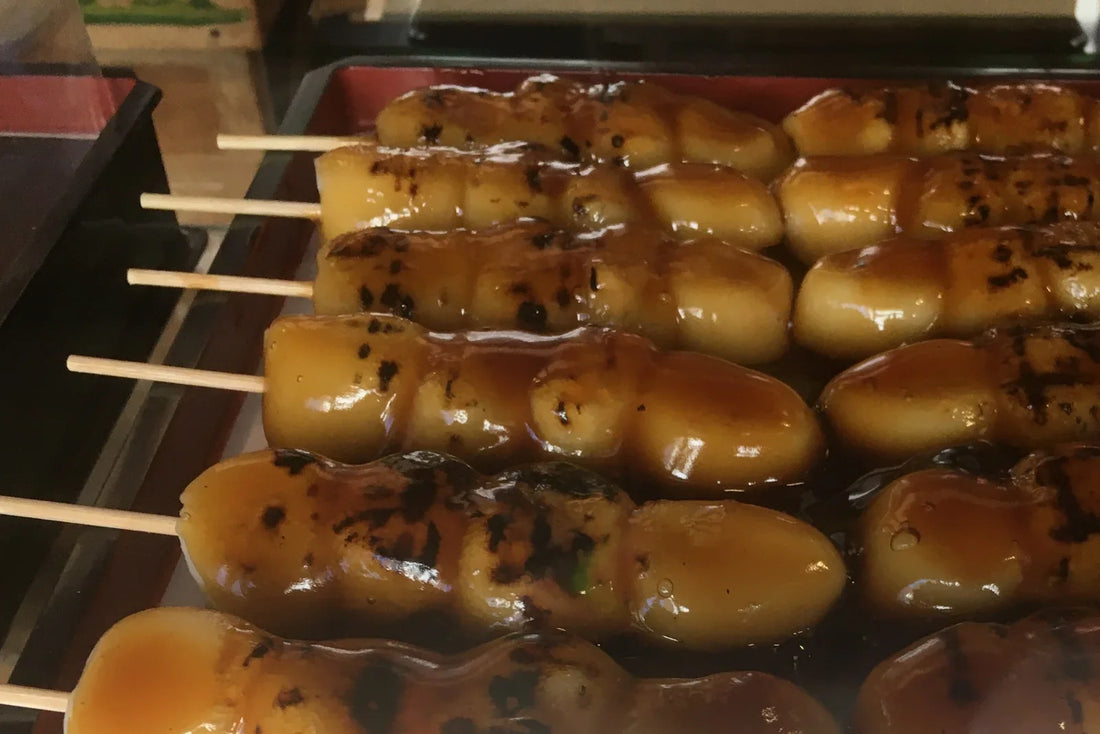
You bought it from a stall, or a station kiosk, or a tray by the till at a temple. Three or four pale dumplings on a bamboo skewer, brushed with something glossy and brown. You expected sweet. You got sweet and salty at once, and a chew closer to a lolly than to any dumpling you had eaten at home.
Let's sort out the names. Find the one you remember below. The word in bold is what to search for. And if you want one in your hand, where to find dango in Australia names who ships it here, and what to ask for when the skewer itself won't travel.
Quick answer
- What it isSweet rice dumplings on a bamboo skewer, three or four to a stick, with a chew closer to a lolly than to a dumpling.
- Not all of it is sweetThe most common kind is glazed and tastes sweet and salty at once, and a few kinds are not sweets at all.
- Getting some hereFresh dango is made and eaten the same day, so it barely exists over a counter here. A few packaged versions ship, and the flour travels perfectly well. Where to find it
The types of dango, and which was on your skewer
-

Mitarashi dango (みたらし団子)
Plain pale dumplings under a glossy brown glaze, often lightly scorched
the glaze is soy sauce and sugar thickened with kuzu — no bean in it
-

Hanami dango (花見団子)
Pink, white and green on one skewer, with no sauce at all
also sold as sanshoku dango, three-colour dango; the pink is colouring and the green is usually mugwort
-

An dango (あん団子)
Dumplings buried under a thick dark paste, sweet the whole way through
the paste is anko, sweetened red bean — the dark filling in most Japanese sweets
-

Kusa dango (草団子)
Deep green all the way through, herbal rather than sweet, often with red bean
the green is yomogi, mugwort — not matcha, and it doesn't taste of tea
-

Kinako dango (きな粉団子)
Dusted in a pale tan powder that catches in your throat if you inhale
the powder is kinako, roasted soybean flour — nutty, barely sweet
-

Goma dango (ごま団子)
Coated in a near-black paste, glossy, with a strong toasted sesame smell
black sesame; not to be confused with the fried Chinese sesame ball sold under the same characters
-

Cha dango (茶団子)
A softer, flatter green than kusa dango, and it does taste of tea
a speciality of Uji, the tea town outside Kyoto
-

Tsukimi dango (月見団子)
Plain white balls stacked in a pyramid, not on a skewer at all
the moon-viewing offering; around Osaka and Kyoto it's elongated and wrapped in red bean instead
-

Botchan dango (坊っちゃん団子)
Three balls on a short skewer, each one coated in a different colour of paste
from Matsuyama, a city in the south-west; the coating is on the outside, not through
-

Sasa dango (笹団子)
Wrapped in long green leaves and tied at both ends, sold in bundles
a speciality of Niigata, on the north-west coast; the leaf is bamboo grass, and you unwrap it
-

Dangojiru (だんご汁)
Miso soup with flat pale strips of dough in it — not a sweet
a dish from Ōita, in Japan's south-west; the reason "dango means Japanese sweet" isn't quite true
Dango and mochi are not the same thing
Both are pale, both are chewy, and Australian menus use the words as if they were interchangeable. The line is the method. Mochi starts as whole glutinous rice grains, steamed and then pounded. Dango starts as flour: rice flour, and in some regions wheat or millet flour. That is mixed with water, rolled into balls and steamed or boiled.
That difference is why dango holds a neat sphere and mochi slumps, and why a dango skewer survives being carried around a festival, in the other hand from a ramune bottle out of the stall's ice tub.
The rule leaks in both directions. There are mochi dishes built from flour, and there are dango made with glutinous rice. If you've eaten something that seemed to be both, that's not your mistake. The line between the two really is blurred.
The one with the glossy brown sauce
This is the dango most visitors meet, and the one most likely to surprise them. The glaze is soy sauce and sugar, thickened with kuzu starch. It's salty and sweet in the same mouthful, and there's no red bean anywhere in it, which is why it doesn't taste like the Japanese sweets you may have been warned about.
The name comes from Shimogamo Shrine in Kyoto, and from the Mitarashi pond in its grounds where worshippers rinse their hands before praying. The skewer sold there stands for a human body: one dumpling set apart at the top, then four below: a head, and four limbs. Skewers in old Tokyo carried five too, and each dumpling cost one coin.
Most skewers carry four now, and the reason is currency rather than taste. In 1768 Japan minted a new coin worth four of the old ones. One coin was easier to hand over than five, so sellers took a dumpling off the stick to match it.
The sweet is old and the sauce isn't. Mitarashi dango goes back to 1587, and to a huge open-air tea party that Toyotomi Hideyoshi, the warlord then ruling Japan, threw in Kyoto. The soy-and-sugar glaze that now defines it was the work of a tea house beside the shrine in the Taishō era, barely a century ago.
The pink, white and green one
You met this one under the cherry blossom, or in a convenience store in early spring. It's the flower-viewing dango, and the colours are appearance rather than flavour: the pink is food colouring, the white is plain, and the green is mugwort or colouring.
There's no fixed meaning behind the three colours.
The blossom isn't always the main event. Enough people at enough flower-viewings walked straight past the trees to the tea stall that the habit earned its own phrase: hana yori dango, dumplings rather than blossom. It's still what you say about anyone who takes the substantial thing over the beautiful one.
The green one that is not matcha
Green in a Japanese sweet is assumed to be green tea. Here it's a herb. Kusa dango is coloured and flavoured with yomogi, Japanese mugwort, which tastes grassy and slightly bitter and not remotely of tea. If you tried it expecting matcha, that mismatch is the whole explanation.
The green wasn't always mugwort. A thousand years ago it came from hahakogusa, cudweed, whose Japanese name means "mother-and-child grass". The story goes that pounding a plant called mother-and-child came to sound like pounding a mother and child, and by the 1500s mugwort had taken over. A few areas still use the old herb.
The ones that are not sweets at all
Every guide that calls dango "a Japanese sweet" has a member it can't account for. Dango began as a word for a small round lump of something, and the sweet is only its most famous use.
In Ōita, in Japan's south-west, dangojiru is a savoury miso soup in which the dango are flat strips of wheat dough, hand-pulled, cooked in a broth with burdock, carrot, mushroom and pork. The same dough dusted with kinako and sugar becomes a local sweet called yaseuma: one dough, two dishes, one of them dinner.
You may also see nikudango on a menu. It means meatballs, not a sweet. That is because dango does not always mean dessert in Japanese.
Where to find dango in Australia
Fresh dango is made and eaten the same day. That's why it barely exists as a counter product outside Japan, and why the answer here has two halves: the small number of packaged versions that ship, and the flour, which travels perfectly well. Checked in September 2026 on each retailer's own online store. A name is where to look, not a promise it's on the shelf today, and the prices here are a rough guide rather than a quote.
Ready to eat
JFC, the Japanese food distributor, sells to the public online and lists ABE's Inakafu mitarashi dango. That's the one kind that reliably makes the trip, and it's also the kind most people are looking for.
Asian Pantry lists Yuki & Love's Japanese Dango in coconut and red bean, made in Taiwan, sold under the Japanese name, and closer to a filled ball than to a skewer. Snack Affair lists an instant dango dessert you finish at home. Across these, expect roughly $6 to $12 a pack.
The flour, which is the better answer
Dango is flour and water. That's the whole recipe, and it means the ingredient crosses the world in a way the finished skewer can't.
Genki Mart lists Maehara dango flour. Jun Direct, which has supplied Japanese groceries in Australia since 1976, lists Mitake shiratamako, a glutinous rice flour, and Tamasan's instant shiratama dough. Boiled, drained and skewered, that flour becomes the thing you were looking for in about twenty minutes, and mitarashi glaze is soy sauce, sugar and a starch you already own. A 150 to 250 gram pack of the flour usually runs around $5.50 to $8.
Over a counter
No Australian shop lists dango made fresh on its own menu. Wagashi means traditional Japanese sweets. Japanese bakeries and wagashi counters concentrate on three other things: daifuku, dorayaki and warabimochi. That's a soft mochi ball around sweet bean paste, two small pancakes sandwiching the same paste, and cubes of bracken-starch jelly dusted in a nutty soy flour. Those we can point you at: the shopfronts are listed by city in our guide to naming Japanese sweets. If dango turns up on a counter near you, tell us where and we'll go and check it.
Common questions
Is dango just mochi?
No, and the difference is the method. Mochi is whole glutinous rice, steamed and pounded. Dango is flour mixed with water, rolled and cooked. The rule has exceptions in both directions, which is covered above.
Is dango a Japanese sweet?
Usually, but not always. It belongs to the wider family of traditional Japanese sweets, alongside daifuku, dorayaki and yokan, and our guide to naming Japanese sweets covers the rest of it. The word itself means a small round lump, which is why dangojiru is a savoury soup and nikudango is a meatball.
Why is dango pink, white and green?
That's hanami dango, eaten under the cherry blossom. The pink is food colouring, the white is plain, and the green is usually mugwort. The colours mark the season rather than the flavour, and there's no fixed meaning behind them.
What does dango taste like?
The dumpling itself is barely sweet and mildly rice-flavoured; the topping is what you taste. Mitarashi is salty-sweet soy glaze, kinako is nutty, kusa dango is grassy and herbal. The texture is dense and chewy, closer to a lolly than to a dumpling.
Is dango gluten free?
The classic rice-flour dango contains no wheat, but plenty of versions do: dangojiru is wheat dough, and glazes and coatings vary by maker. Read the pack rather than assume, and check with the shop if it's made on site.
Which one should I try first?
Mitarashi. It's the most widely sold, it's the one you're most likely to have already met, and the soy-and-sugar glaze is the least demanding introduction for a palate that doesn't yet like red bean.
How long does dango keep?
Freshly made dango is a same-day food, which is the single fact that shapes everything below. Packaged versions carry a date on the pack; go by that date and nothing else.
Where this leaves you
The name you wanted is almost certainly mitarashi, and the reason you couldn't find it here's the same reason it tasted so good there: it was made that morning to be eaten that afternoon.
We stock one corner of this family, and it's the opposite corner: yokan, three Kinjo Seika bars, the one sweet in the family built to keep at room temperature. Dango is what happens when a sweet is built for today. Yokan is what happens when it's built for the journey. If you're new to the whole category, start here.
Sources
- National Diet Library, Reference Cooperative Database — the form and price of Edo-period skewered dango, citing Edo bukka jiten (1979), Mitamura Engyo Edo seikatsu jiten (1959) and Teihon Edo shōbai zue (1986).
- National Diet Library, Reference Cooperative Database — the origin of mitarashi dango, citing Wagashi no jiten and Tabemono gogen jiten.
- Japanese Wikipedia, 団子 — the flour-and-water definition, the varieties, and the point that the dango/mochi rule has exceptions on both sides.
- Japanese Wikipedia, みたらし団子 and 月見団子 — the glaze, the Shimogamo connection, and the Kantō and Kansai moon-viewing forms.
- Japanese Wikipedia, 草餅 and だんご汁 — the cudweed-to-mugwort change, and the Ōita soup.
- Kotobank, 花より団子 — the proverb and its Edo-period spread.
- Australian availability checked September 2026 on the retailers' own online stores — JFC Online, Genki Mart, Jun Direct, Asian Pantry and Snack Affair.
Photographs — all from Wikimedia Commons, used under the licences shown: Top photograph by Nesnad (CC BY 4.0, cropped); Mitarashi dango by denver935 (CC BY 2.0); Hanami dango by Ocdp (CC0); An dango by Ocdp (CC0); Kusa dango by Ocdp (CC0); Kinako dango by akira yamada (CC BY-SA 2.0); Goma dango by Ocdp (CC0); Cha dango by Kykk wiki (CC0); Tsukimi dango by yomi955 (CC BY 2.0); Botchan dango by Fred Cherrygarden (CC BY-SA 4.0); Sasa dango by Nesnad (CC BY 4.0); Dangojiru by OitaKiseichu (CC BY-SA 3.0).


