

-
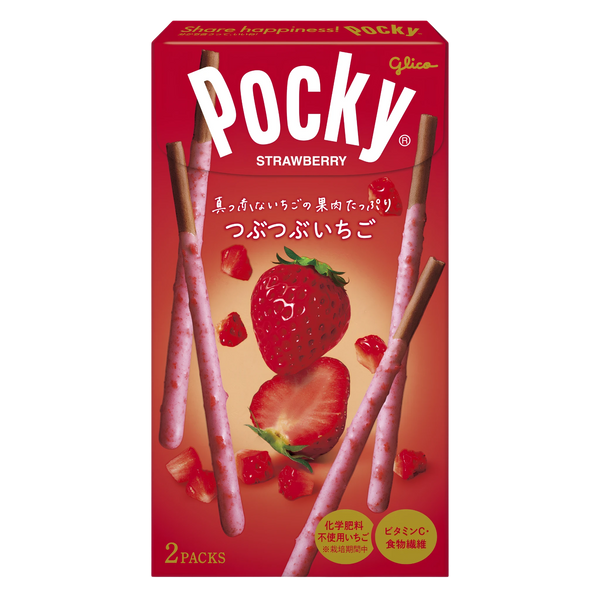 Glico Strawberry Pocky Tsubutsubu Ichigo — 2 Packs$5.45
-
 Glico Pocky Gokuboso Thin Chocolate Sticks — 2 Packs$5.10
-
 Glico Pocky Cacao 60% Bitter Chocolate Sticks — 2 Packs$5.99
-
 Glico Pocky Two-Layer Cacao Chocolate Sticks — 2 Packs$5.49
-
 Glico Salted Caramel Pocky — Winter Edition, 2 Packs$6.33
-
 Glico Coconut Pocky — Chocolate Sticks, 2 Packs$7.37
-
 Glico Choco Mint Pocky — Mint Chocolate Sticks, 2 Packs$7.37
-
 Glico Matcha Pocky 2-Layer Uji Green Tea — 2 Packs$8.30
-
 Glico Matcha Pocky Koi Fukami — Uji Green Tea, 2 Packs$6.10
-
 Glico Pocky Almond Crush Chocolate Sticks — 2 Packs$5.45


Product information
About
Thin wheat biscuit sticks under a real chocolate coating, with a snap you can hear: the biscuit underneath is toasty and faintly salty, which is the half worth paying attention to. This is the Japanese-made box, and its ingredient list names cacao mass (ground cocoa beans), cocoa butter and fermented butter. Buy it if you want the Pocky you remember from Japan; if you just want a cheap chocolate stick for a lunchbox, the supermarket carries one for a fraction of this and it will do that job fine.
The pack reads ポッキーチョコレート: pok-kee choco-rey-to.
What you're getting
- Not the same recipe as the supermarket box. The Pocky Australian supermarkets sell is made in Thailand: every line of it that states an origin says so on Coles' own product pages. On the export pack whose full panel we could read, the coating is not called chocolate at all but chocolate flavoured cream, built on palm and rapeseed oils with no cocoa butter in it. This one is made in Japan, which is what a returning traveller is noticing.
- The recipe changed in September 2025, for the first time in ten years. It is still argued over in Japan, and people divide sharply over whether the result is better than what they remember. Worth knowing before you decide your memory is wrong.
- Chill it before you eat it. Cold chocolate goes hard and snaps instead of smearing, and the pack does not tell you. It is the one piece of handling advice worth having with these.
- It will not enjoy a Sydney summer. Glico's own instruction is to keep it below 28°C, and there is chocolate on the outside where the heat reaches it first. In hot weather expect to want it in the fridge, and expect a hot-day delivery to arrive softer than it left.
- Allergens: contains milk, wheat and soy. Read the pack's own label before you rely on ours.
It is a biscuit stick, not a pretzel in the salty-knot sense. Glico prints プレッツェル on the box, meaning the thin baked wheat stick, not the twisted bar-snack kind. It is not Pepero, which is a Korean lookalike made by Lotte, and not Mikado, which is what Glico calls Pocky in Europe. Inside the box are two sealed packs rather than one open tray, which is what makes it easy to take somewhere and open one.
Ingredients
The maker's ingredient list, translated from the Japanese pack. Anything after the break is an additive — the Japanese label lists those separately.
Wheat flour (produced in Japan), sugar, cacao mass, vegetable oil, whole milk powder, wholemeal wheat flour, malt extract, cocoa butter, fermented butter, salt, yeast
emulsifier, flavouring
The printed label on the pack is always the authority on ingredients and allergens, not this page — please read it in full before you rely on our summary. If you are unsure about an ingredient, contact us.
Allergens
The maker declares:
- Allergens
-
- Milk
- Wheat
- Soy
The printed label on the pack is always the authority on ingredients and allergens, not this page — please read it in full before you rely on our summary. If you are unsure about an ingredient, contact us.
Details
- Maker
- Glico
- Prefecture
- Osaka
- Made in
- Japan
- Net contents
- Two sealed packs in one box
Our guide
How to eat it
- Put the box in the fridge before you open it, or the freezer for a shorter while: the chocolate goes hard and snaps rather than softening onto your fingers. The pack does not tell you this.
- Hold a stick by the bare end. Glico left that end uncoated in 1966 so the chocolate stays off your fingers, and it is why a box works passed around a table rather than eaten alone.
- There are two sealed packs inside, so one can stay closed until you want it.
- Keep it below 28°C, which is Glico's own instruction and is not always possible in a Sydney summer. Our advice, not theirs: in hot months keep it in the fridge.
- If it arrives in summer looking dusty or greyish rather than glossy, that is bloom: the cocoa butter has melted and re-set on the surface. It got warm on the way. It is safe to eat and the texture will have suffered.
In their own words
What Japanese buyers say
What do the numbers mean?
Counts of how many reviews mentioned each thing, not a score. One review can mention several. Every quote is our translation, with the original Japanese beneath it.
- What they like
The snappy texture, a faintly salty, sweet, toasty pretzel and milk chocolate that melts smoothly with a rounded sweetness — the balance is exquisite, a deliciousness nothing else has.
ポキポキっとした食感で微かに塩気が効いた甘く香ばしいプレッツェルと滑らかな口溶けで円やかな甘さのミルクチョコレートとのバランスが絶妙で唯一無二の美味しさ
from mognavi
- What they like
Bought it as a snack with my daughter. It gives the impression of having become a luxury item. The biscuit is crisp and delicious. There were plenty of sticks inside, befitting the price.
娘とおやつに購入。 高級品になった印象。 クッキーがカリッとしていて美味しい。 値段にふさわしくたくさん本数が入っていました。
from monolog
- What they like
The snack part is toasty and delicious. The chocolate isn't too sweet either — delicious.
スナックの部分が香ばしくて美味しい。チョコも甘すぎず美味しい。
from monolog
- What they grumble about
The taste has changed a great deal. I preferred the old one. I enjoyed this on its own terms, but I want them to bring the old one back!
味が大分変わりました。前の方が好きでした。これはこれで美味しく食べましたが、前のをまた出して欲しいです!
mentioned in ~10 of 55 reviews we readfrom monolog
- What they like
Pocky for the first time in ages. Really, in ages. It's delicious after all. The thinness is just right too.
久しぶりのポッキー。ほんとに久しぶり。やっぱり美味しい。細さもちょうど。
from monolog
- What they like
I always freeze them and eat them crunching away at the chocolate. It's the best.
いつも冷凍して、チョコをぽりぽり齧りながら食べてます。最高です
mentioned in 4 of 55 reviews we readfrom monolog
- What they like
I bought it to take to a friend's house. Because there are two individually wrapped bags inside, it's easy to share with a friend, which is a help. The taste is delicious too — I love it!
友達のお家に遊びに行く時に購入しました。個包装が2つ入っているので、友達とシェアしやすくて助かっています。味も美味しくて好きです!
mentioned in 3 of 55 reviews we readfrom monolog
- What they grumble about
I ate it after a long time. Lately I only occasionally eat the individually wrapped family type (is that what it's called?). So this felt like a bit much.
久しぶりに食べました。最近は個包装のファミリータイプ(って言うのかな?)をたまに食べるくらい。なので少し多く感じました。
from monolog
- What they like
It's split into two wrapped bags so you can spread it over separate days. The same gentle taste as ever.
2つの包装袋にわかれてるので日にちで分けれる。変わらぬ優しい味。
from monolog
- What they like
I ate Pocky for the first time in ages. Since I started being careful about food I'd avoided big-manufacturer snacks because they're full of additives, but surprisingly Pocky didn't have anything strange in it. It tasted good too.
ポッキーすごいぶりに食べました 食べ物に気を使うようになってから大手メーカーのお菓子は添加物だらけなので避けてたのですが、意外とポッキーは変なの入ってなかった 食べても美味しかったです
from monolog
- What they like
This is Pocky's chocolate. Lovely aroma and flavour, very delicious.
ポッキーのチョコレートです。香味良くとても美味しいです。
from monolog
- What they like
Were they always this thin? I ate them with nostalgia and enjoyment.
こんなに細かったかな?懐かしく美味しく食べました。
from monolog
- What they grumble about
I bought it after seeing on TV that it had been renewed, but I feel the old one tasted better. It feels like the sweetness has gone…
テレビでリニューアルしたとの事で購入してみたが、以前のほうが美味しかった気が。甘さがなくなった気がする…
from monolog
- What they like
I eat it as Pocky and Pretz.
ポッキー&プリッツで食べる
from monolog
- What they like
I always waver over which to get, this or the thin one, and end up buying both. I'm fond of them.
いつも細いのとどちらにしようか迷って結局どちらも購入。気に入っています
from monolog
- What they like
This is an item I can't do without. As it has been, so it will be…
これは私には欠かせないアイテムです。 これまでもこれからも…
from monolog
- What they like
I bought some because it's Pocky Day. For the children's snack.
ポッキーの日なので買ってみました。子供のおやつに。
mentioned in 5 of 55 reviews we readfrom monolog
Real quotes from Japanese review sites (mognavi, monolog), translated by us. We show no star rating from those sites.
The maker
Where it comes from
- Glico
- Osaka
Glico spent years trying to sell a chocolate-coated version of Pretz, its thin baked wheat stick, and kept running into the same problem: the chocolate came off on your fingers. The fix arrived in 1966, when a developer left one end of the stick bare. There's somewhere to hold it. That is the entire product, and it went on sale as the world's first stick chocolate.
The name is onomatopoeia. Pocky comes from pokin: the sound the stick makes when it snaps.
The recipe was rebuilt in September 2025, the first change in ten years and the sixtieth year of the product. Glico went back through more than a hundred raw materials, took out the shortening and the raising agent, put Japanese wholemeal flour and fermented butter into the biscuit, and re-blended the cacao from more than thirty origins. It is a simpler ingredient list than the one before it, which was the stated point.
Product facts here are checked against the maker's own page: glico.com (opens in a new tab)
Often bought together
-

Glico Japanese Pocky Chocolate Sticks — 2 Packs
$5.10
You are on this one
